What Does the Prostate Do? Function, Location, & Conditions
Your prostate works quietly for decades, and most men never think about it until something goes wrong. This small gland below the bladder plays a central role in reproduction by producing fluid that makes semen — about 20–30% of its volume, according to the Cleveland Clinic (health system), and this guide walks through the facts with clear sources.
Size: About the size of a walnut · Weight: About 1 ounce (28 grams) · Location: Below the bladder, surrounding the urethra · Function: Produces fluid that makes up 20–30% of semen
Quick snapshot
- Produces seminal fluid (Cleveland Clinic (health system))
- Nourishes sperm (WebMD (medical publisher))
- Propels semen during ejaculation (Cleveland Clinic)
- Below the bladder (Cleveland Clinic)
- Surrounds the urethra (Mayo Clinic (medical center))
- Accessible via rectal exam (Cleveland Clinic)
- Enlarged prostate (BPH) (WebMD)
- Prostatitis (inflammation) (Mayo Clinic)
- Prostate cancer (American Cancer Society (cancer research org))
- Diet may affect prostate health (American Cancer Society)
- Regular ejaculation may reduce risk (Prostate Cancer UK (charity))
- Exercise and weight management help (Johns Hopkins Medicine (research hospital))
The table below shows baseline measurements and facts about the prostate — useful for spotting what’s normal and what might signal a change.
| Factor | Value |
|---|---|
| Average weight | 20–30 grams (Cleveland Clinic) |
| Daily fluid production | 0.5–1 ml (NCBI (U.S. medical research database)) |
| Number of lobes | 4 (anterior, posterior, lateral, median) (Cleveland Clinic) |
| Age of common enlargement | After age 40 (Mayo Clinic) |
| Role in reproduction | Vital for fertility (Prostate Cancer UK) |
What are the 3 functions of the prostate gland?
Production of seminal fluid
The prostate’s primary job is to produce prostatic fluid, a key component of semen. This fluid makes up about 20–30% of the total volume of semen and contains enzymes, zinc, and other substances that nourish and protect sperm (Cleveland Clinic).
Secretion of fluid during ejaculation
During ejaculation, the prostate contracts and forces its stored fluid into the urethra, where it mixes with sperm from the testicles and fluid from the seminal vesicles. The combined mixture is then expelled (WebMD).
Nourishment and protection of sperm
The prostatic fluid contains substances like citric acid, calcium, and phosphate that help keep sperm viable. The prostate also secretes an enzyme called prostate-specific antigen (PSA) that liquefies semen, allowing sperm to swim freely (Prostate Cancer UK).
The prostate is essential for natural conception, but it is not needed for urination or survival — a fact that becomes critical when prostate cancer requires removal.
The implication: Without the prostate’s fluid, men cannot produce semen, but they can still achieve orgasm and live a full life.
Where is the prostate located?
Position relative to the bladder
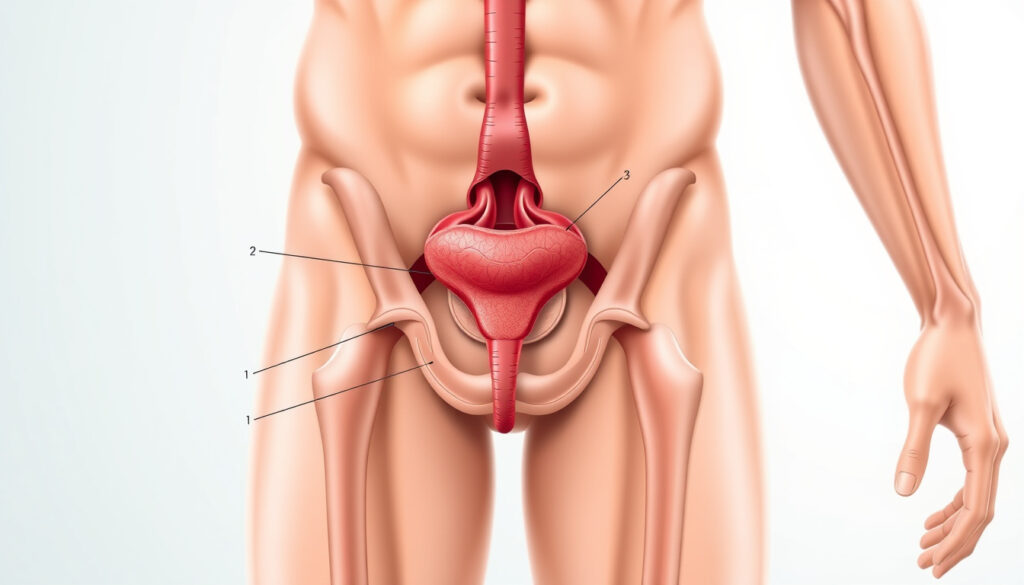
The prostate sits directly below the urinary bladder and in front of the rectum (Cleveland Clinic). This location means changes in the prostate directly affect bladder function.
Surrounding the urethra
The prostate encircles the urethra, the tube that carries urine from the bladder out of the body (Mayo Clinic). When the prostate enlarges, it presses on the urethra and restricts urine flow.
Relationship with the rectum
Because the prostate lies directly in front of the rectum, it can be felt during a digital rectal exam (DRE) — a key screening technique (Johns Hopkins Medicine).
A simple finger exam can reveal an enlarged or irregular prostate long before symptoms appear, giving patients and doctors an early window for intervention.
The catch: The same location that makes the prostate easy to examine also makes it easy to cause urinary or sexual side effects during surgery.
What are the first signs of prostate problems?
Urinary symptoms
- Frequent urination, especially at night (WebMD)
- Difficulty starting or stopping urination (Mayo Clinic)
- Weak or interrupted urine stream (American Cancer Society)
Pain or discomfort
Men may notice a burning sensation during urination or ejaculation, or persistent pain in the lower back, hips, or pelvic area (Prostate Cancer UK).
Blood in urine or semen
The presence of blood (hematuria) in urine or blood in semen can be a sign of infection, inflammation, or cancer. It always warrants medical evaluation (Johns Hopkins Medicine).
Early urinary changes are often dismissed as just getting older — but catching BPH or cancer early can dramatically change the treatment options and quality of life.
The pattern: Urinary symptoms are nearly universal, but many men wait months before talking to a doctor — time that can matter for treatment success.
What happens if the prostate is removed?
Effects on fertility
Radical prostatectomy removes the entire prostate and often the seminal vesicles (Johns Hopkins Medicine). Because the prostate produces most of the fluid in semen, removal eliminates semen production entirely (American Cancer Society). Men experience “dry orgasms” — the sensation of orgasm without ejaculation of fluid (Prostate Cancer UK).
Urinary changes
After removal, the bladder and urethra are reconnected (UCLA Health (university medical center)). Some men experience temporary or permanent urinary incontinence. Pelvic floor exercises are strongly recommended to strengthen the muscles that control urine flow (Mayo Clinic).
Sexual function after surgery
Nerve-sparing techniques can preserve erectile function in some cases, if the cancer does not require removal of the nerves (Johns Hopkins Medicine). However, many men experience erectile dysfunction after surgery, and recovery can take months or years (Prostate Cancer UK).
Men can live without a prostate — it is not essential for survival, but its removal has permanent consequences for fertility and may affect urinary control and erections. The decision to operate balances cancer risk against quality of life.
The trade-off: For men with localized prostate cancer, radical prostatectomy offers a strong chance of cure, but the side effects require careful consideration and preparation.
Is ejaculating every day good for your prostate?
Possible benefits
Some observational studies have found that men who ejaculate more frequently (often 21 or more times per month) have a lower risk of prostate cancer (Prostate Cancer UK). The theory is that regular ejaculation may flush out carcinogens from the prostate ducts.
Risks and considerations
There is no evidence that daily ejaculation is harmful for most men (WebMD). However, the link between ejaculation frequency and cancer prevention is not yet definitive. The American Cancer Society notes that the data is observational, not causal.
Balance and moderation
Individual health factors matter. For men with existing prostate conditions, a doctor’s advice should come first. The consensus: regular ejaculation is likely neutral or slightly beneficial, but it is not a substitute for screening or a healthy lifestyle (Johns Hopkins Medicine).
While men worry whether ejaculation is harmful, the available evidence points the other way: moderate to frequent ejaculation may actually be a protective habit — just not one you should rely on instead of a PSA test.
The implication: Don’t count on frequency alone for protection. The strongest risk-reduction strategies remain diet, exercise, and regular screening after age 40.
What we know vs. what remains unclear
Confirmed facts
- Prostate produces seminal fluid (Cleveland Clinic)
- Prostate surrounds the urethra (Mayo Clinic)
- Prostate removal stops semen production (Johns Hopkins Medicine)
- Enlargement is common with age (WebMD)
What’s unclear
- Whether daily ejaculation prevents prostate cancer definitively (American Cancer Society)
- Exact mechanisms of prostatitis (Mayo Clinic)
- The role of diet in reversing prostate enlargement (Prostate Cancer UK)
What the experts say
“The prostate is about the size of a walnut and weighs around 1 ounce. Its main job is to help produce the fluid that nourishes and transports sperm.”
— Cleveland Clinic (health system)
“The prostate contributes fluid to semen that helps protect sperm and keep them healthy. Without this fluid, men cannot father children naturally.”
“Men can live a full life without a prostate. The gland is not needed for survival, but it is essential for natural reproduction.”
These three perspectives — from a major hospital, a national research body, and a patient charity — reinforce the central message: the prostate matters most for fertility, but your body can function without it.
Moving forward: What this means for you
The prostate is a small gland with a big role in reproduction, but it is not essential for life. Understanding its function helps you interpret the first signs of trouble — urinary changes, pain, or blood — and know when to see a doctor. For men over 40, the choice is clear: get a baseline PSA test and digital rectal exam, or risk discovering a problem when treatment options are narrower and side effects harder to manage.
Understanding the prostate’s function is the first step toward recognizing potential issues, and learning about prostate cancer helps identify early symptoms and treatment options.
Frequently asked questions
Can you live without a prostate?
Yes. The prostate is not necessary for survival. It is important for reproduction because it produces seminal fluid, but men can live a full life after prostate removal (Johns Hopkins Medicine).
What are the worst foods for prostate health?
High consumption of red meat, processed meats, and high-fat dairy products has been linked to worse prostate health outcomes. Diets rich in saturated fat may increase inflammation and cancer risk (American Cancer Society).
How do I get my prostate back to normal?
If you have an enlarged prostate, treatments range from lifestyle changes (diet, exercise) to medication (alpha-blockers, 5-alpha reductase inhibitors) to minimally invasive procedures. There is no single “return to normal” approach — it depends on the cause (WebMD).
What does an enlarged prostate do?
An enlarged prostate (benign prostatic hyperplasia, BPH) presses on the urethra, making it harder to urinate. It can cause frequent urination, weak stream, and nighttime trips to the bathroom (Mayo Clinic).
Can a man get a hard on after prostate surgery?
Yes, if nerve-sparing techniques are used and the cancer does not require removal of the nerves. Erectile function may return gradually over months. Medication, vacuum devices, or injections can help (Johns Hopkins Medicine).
More related posts
 Flu A Symptoms 2025: What to Know and How to Treat
 Demon Slayer Infinity Castle Movie Release Date: 2025, 2027, 2029
 iPhone 13 Release Date: When It Came Out & Still Worth Buying
 Storm Damage Restoration Near Me: How to Vet Contractors
 Law of Conservation of Mass: Definition, History & Examples
 Weeds (TV Series): Cancellation, Reboot & Streaming
 Amazon Customer Service Number – US, UK & Ireland Info
 YouTube MP3 Download Converter: Best Free Tools Compared
