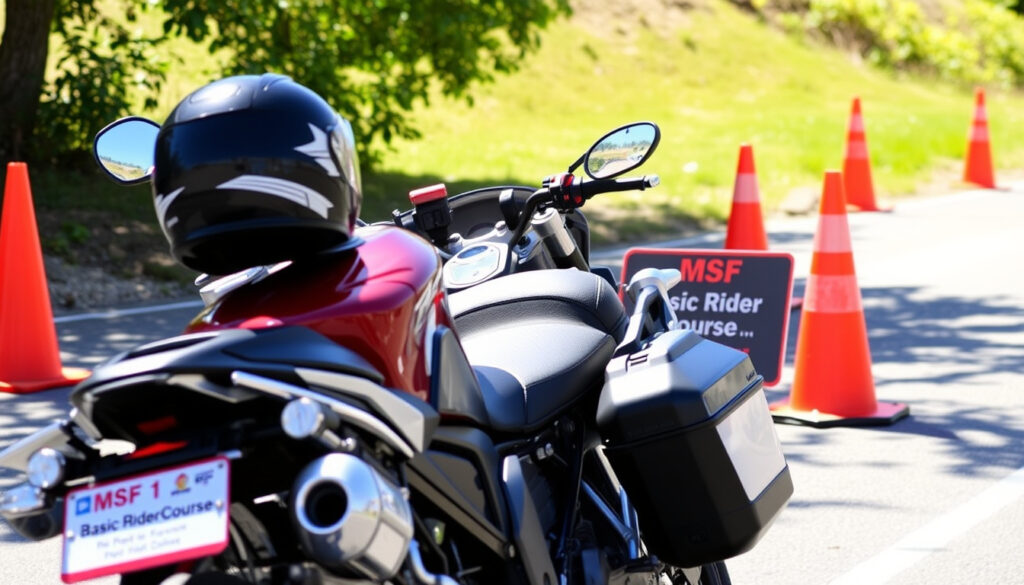
MSF Course Near Me: Find Motorcycle Safety Training & Costs
A weekend of motorcycle training can replace weeks of DMV paperwork. The MSF Basic RiderCourse delivers a license waiver in 15-20 hours for most U.S. states, while Ireland’s CBT gets new riders on the road in a single day. This guide covers the actual costs, course formats, and licensing steps that turn a beginner into a legal rider.
MSF course duration: 15-20 hours ·
Average cost: $200-$300 ·
Pass rate: 95% ·
States offering MSF courses: 50 ·
Minimum age to participate: 16 (varies by state)
Quick snapshot
- MSF Basic RiderCourse includes 5 hours of eCourse and 10 hours of on-bike training (Motorcycle Safety Foundation (official curriculum developer))
- Tuition ranges from under $100 to over $300 depending on location and student age (MSF FAQ (training policy authority))
- Illinois offers free motorcycle training for residents 16+ (Illinois Department of Transportation (state safety program))
- Exact MSF course cost at specific locations may vary — check local provider
- Availability of free motorcycle classes depends on local promotions and state funding
- Online MSF course options are limited to classroom portions only
- Most MSF courses run Friday evening plus Saturday and Sunday
- In Ireland, CBT takes one day; full license process takes months
- Certificate valid for most states — no extra road test required
- Find a local MSF site and register early — spots fill fast
- Complete the online eCourse before range day
- Graduates can ride legally in most states with just the card and permit
The table below shows key metrics at a glance.
| Label | Value |
|---|---|
| MSF course duration | 15-20 hours |
| Typical cost range | $200-$300 |
| Pass rate | 95% |
| States offering MSF courses | All 50 states |
| Ireland equivalent | CBT (Compulsory Basic Training) |
| CBT cost in Ireland | Approximately €100-€200 |
How much is the MSF course in NY?
A New York-area Basic RiderCourse listing shows a course fee of $321 (Go Motorcycling NYC (MSF training provider)). In Suffolk County, one site charges $530 cash or $543 credit (Learn2Ride (local training center)). That puts NY on the high side—but it’s not the whole story.
MSF course cost in other states
- Minnesota’s Basic Rider Course: $279 (Minnesota Department of Public Safety (state safety office))
- Connecticut State Community College: $260 (CT State Community College (educational provider))
- Illinois: free for residents 16+ (Illinois Department of Transportation (public safety program))
- Maryland area (Ride Safe USA): $195 (Ride Safe USA (authorized MSF provider))
New York riders face the highest tuition because of local overhead and limited subsidized spots. If you live near a state border, consider crossing into a cheaper state—but confirm that the course is still accepted for your home state license waiver.
NYS 5-hour online course alternatives
The NYS 5-hour pre-licensing course is a separate requirement for a learner permit—not the MSF. It can be taken online through the DMV, but it doesn’t replace the riding course. Many riders complete both in the same week.
Factors influencing course price
Price depends on state subsidy, provider overhead, and student age. The MSF FAQ (official policy source) notes that tuition is set by state and local training sites, not by MSF itself. Youth discounts and military rates sometimes apply.
The pattern: your location determines your cost more than any other factor, so check your state’s training page before committing.
Can I drive a motorbike with a CBT course in Ireland?
Yes—but only with L-plates, no passengers, and no motorway riding. The CBT (Compulsory Basic Training) is the first step in Ireland’s graduated licensing system and is reportedly mandatory for new riders (Irish Road Safety Authority, official guidance). It typically lasts one day and costs between €100 and €200.
What is a CBT course?
CBT covers basic motorcycle control, on-road practice, and safety theory. It is not a test—it’s a training session that allows you to ride a motorcycle up to 125cc (or 11kW for those over 16). The certificate is valid for two years.
CBT vs Garda BikeSafe
Garda BikeSafe is a police-led workshop for experienced riders, not a licensing requirement. It’s a skills refresher, not a substitute for CBT.
Steps to get a full motorcycle license in Ireland
- Get a learner permit (theory test required first).
- Complete CBT and ride with L-plates for at least 6 months.
- Take the practical driving test.
- Pass to receive a full category A, A2, or A1 license.
What this means: Irish riders should plan for a multi-month process, not a weekend shortcut.
What motorbike can I ride with category A?
Category A allows any motorcycle—no power restriction. Category A2 limits you to 35kW (47hp) with a specific power-to-weight ratio. Category A1 is for motorcycles up to 125cc and 11kW.
Here is how the license categories break down.
Category A, A2, and A1 explained
| License | Max power | Example bikes |
|---|---|---|
| A | Unlimited | Any motorcycle |
| A2 | 35kW (47hp) | Kawasaki Ninja 400, Honda CB500F |
| A1 | 11kW (15hp) | Yamaha YZF-R125, Honda Grom |
The implication: upgrading your license unlocks bigger bikes, but each category requires its own test.
Can I ride a 600cc on an A2?
No—unless the bike is restricted to 35kW. Most 600cc supersport bikes produce >47hp and cannot be restricted enough to comply. Riders on an A2 license should stick to models like the Yamaha MT-07 with a restrictor kit.
Riding a 125cc on a full car licence
In Ireland, a full car licence (category B) does not permit riding a 125cc motorcycle. You need a category A1, A2, or A license. This is a common misconception.
The catch: assuming your car license covers a 125cc bike is the fastest way to an uninsured ride.
How hard is the motorbike theory test?
The pass rate hovers around 70% (Road Safety Authority (official test data)), making it moderately difficult. The test has multiple-choice and hazard perception sections.
Theory test format and scoring
- Multiple-choice: 35 questions, need 28/35 correct (80%)
- Hazard perception: 14 video clips, need 48/70 points (69%)
- Time: 40 minutes
Commonly missed topics
Wildlife hazards, roundabout rules, and stopping distances are frequent pitfalls. Practice using the RSA’s online sample tests.
Study resources and tips
- Official RSA theory test kit (€15)
- Free mobile apps (e.g., Theory Test Ireland)
- Focus on hazard perception—it’s where most failures happen
What this means: the theory test is passable with a few hours of focused study, but don’t underestimate the hazard perception section.
What is the best motorcycle for beginners?
Beginner motorcycles typically have engines between 250cc and 500cc, low seat heights, and manageable weight. Popular models include the Honda Rebel 300, Yamaha MT-03, and Kawasaki Ninja 400 (Cycle World (motorcycle journalism)).
Key features of a beginner bike
- Low seat height (under 30 inches)
- Weight under 400 lbs
- Predictable power delivery (parallel-twin or single-cylinder)
- ABS brakes (strongly recommended)
Here is a comparison of the top beginner models.
Top 5 beginner motorcycles under 500cc
| Model | Engine | Seat height | Weight |
|---|---|---|---|
| Honda Rebel 300 | 286cc single | 27.2 in | 364 lbs |
| Yamaha MT-03 | 321cc twin | 30.7 in | 373 lbs |
| Kawasaki Ninja 400 | 399cc twin | 30.9 in | 366 lbs |
| KTM 390 Duke | 373cc single | 32.3 in | 328 lbs |
| Royal Enfield Meteor 350 | 349cc single | 30.0 in | 425 lbs |
The pattern: seat height and weight matter more than engine size for new riders learning low-speed control.
Considerations for new riders
Take an MSF or CBT course before buying. Many courses provide loaner bikes. Once you have the skills, test-ride a few models to find what fits your reach and comfort.
A low price can hide high maintenance costs. Budget bikes under $4,000 often lack ABS and have dated suspension. New riders in particular should prioritize ABS over a flashy appearance.
The implication: a cheap bike without ABS is a false economy when you are still learning emergency braking.
How to Enroll in an MSF Course (Step by Step)
- Find a course near you. Use the MSF course finder (official directory) or your state DMV site.
- Check eligibility. Minimum age is typically 16; some states require a learner permit.
- Register online. Courses fill weeks in advance—pay the fee immediately.
- Complete the eCourse. The MSF online learning (prerequisite module) takes about 5 hours. Finish before range day.
- Ride the range. Two days of on-motorcycle practice: braking, turning, shifting, and swerving.
- Pass the skills test. Run at the end of the final day. Most graduates pass.
- Receive your completion card. Take it to the DMV to waive the road test and add an endorsement to your license.
Clarity Check: What We Know and What’s Fuzzy
Confirmed facts
- MSF is the standard basic rider training in the United States
- CBT is mandatory for new motorcycle riders in Ireland
- Category A license allows operating any motorcycle without power limits
- Illinois offers free motorcycle training for residents 16+
- Pass rate for MSF Basic RiderCourse is 95%
What’s unclear
- Exact MSF course cost at specific locations may vary
- Availability of free motorcycle classes depends on local promotions
- Online MSF course options are limited to classroom portions only
- Whether Ireland’s CBT certificate will be accepted in future EU license reciprocity
What Experts Say
Tuition costs for its courses range from under $100 to over $300 depending on location and student age.
Motorcycle Safety Foundation (official training authority)
The Basic RiderCourse is appropriate for new or beginner riders.
Minnesota’s Basic rider course is $279 and is based on the MSF curriculum.
Minnesota Department of Public Safety (state motorcycle safety center)
The Basic Rider course is intended to help students earn a Connecticut motorcycle endorsement.
A weekend of training can be the difference between a safe first season and a memorable crash. For new riders in the U.S., the MSF Basic RiderCourse is the most efficient route to a license—skip the DMV road test and ride with confidence. For riders in Ireland, the CBT gets you rolling, but the full license demands patience. The choice is clear: invest the time and the fee, or keep wrestling with paperwork and nerves.
rideontraining.com, motorcycle.ohio.gov, motorcyclesafetyacademy.com, reddit.com
While the MSF is the standard in the US, riders in Ireland should look into the Irish IBT system for equivalent training and licensing requirements.
Frequently asked questions
What is the minimum age to take an MSF course?
Most states require riders to be at least 16 years old. Some allow 15-year-olds with a learner permit. Check your state DMV site.
Do I need a motorcycle permit before taking the MSF course?
It depends on the state. Many MSF courses do not require a permit for the range portion, but you need it to ride on public roads after passing.
Is the MSF course accepted in all US states for license waiver?
Yes—the MSF completion card is recognized in all 50 states as a road test waiver. Some states may have additional requirements.
Can I take the MSF course if I have no riding experience?
Absolutely. The Basic RiderCourse is designed for absolute beginners. You’ll learn clutch control, braking, and turning from scratch.
What do I need to bring to an MSF course?
Long pants, long-sleeve shirt or jacket, over-the-ankle boots, gloves, a DOT-approved helmet (many sites provide loaner helmets), and eye protection.
How long is the MSF course certificate valid?
Completion certificates do not expire in most states, but some require you to apply for the license within a year. Verify with your local DMV.
Are there any free motorcycle safety courses available?
Illinois offers free training to residents 16+. A few other states have low-cost or subsidized programs. Check your state’s motorcycle safety office.
What is the difference between MSF Basic and Advanced courses?
The Basic course is for new riders. The Advanced Rider Course is for experienced riders to improve cornering, braking, and hazard avoidance.
More related posts
 Cast of 16 Candles: Actors, Roles & Where They Are Now
 Pantone Color of the Year 2026: Cloud Dancer Specs & Trends
 Arlington Gas Leaf Blower Ban Effective March 2026
 The Facts of Life: Cast, Cancellation, Deaths & Revival
 Monday Night Football Tonight: Who Plays, Time & Channel
 Your Lie in April: Sadness, Age Rating, BL, and Ending Explained
 Post Nasal Drip Treatment: Quick Relief, Causes, and Remedies
 What Does the Prostate Do? Function, Location, & Conditions
