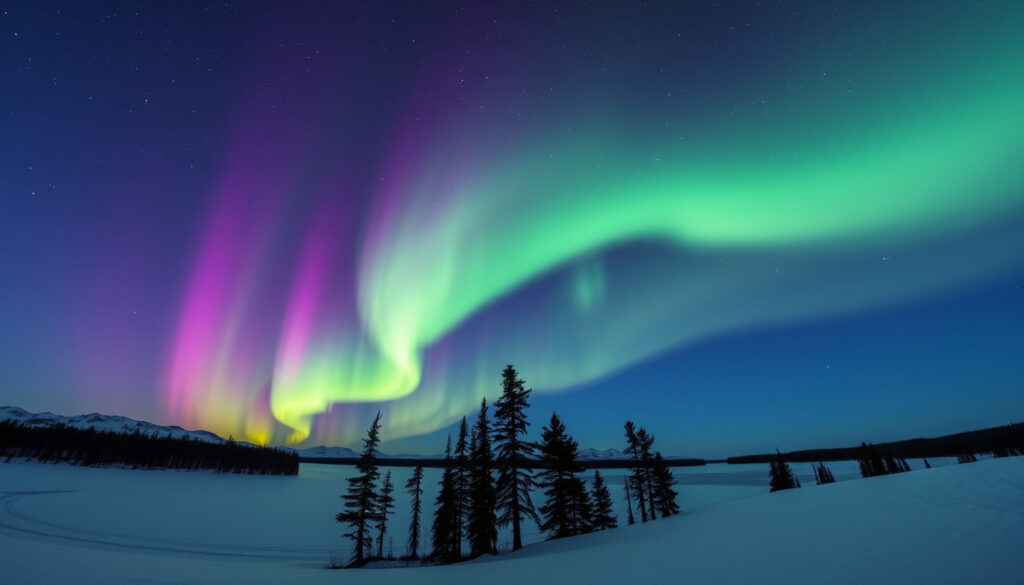
Northern Lights Aurora Borealis 2026: Forecast & Best Viewing
Anyone who has ever glanced up at a clear winter sky and hoped for a green glow knows the feeling. For those in Ireland and the UK, the aurora borealis isn’t just a bucket-list trip to the Arctic — it’s a real possibility when solar conditions align. With Solar Cycle 25 heading toward its predicted peak in 2026, this may be the best chance in a decade to see the northern lights without leaving home.
Best visibility latitude: 65° to 72° North ·
Peak activity years (Solar Cycle 25): 2024-2026 ·
Typical altitude of aurora: 100-400 km (60-250 miles) ·
Primary colors observed: Green (most common), red, purple, blue ·
Forecast lead time from NOAA: 30 minutes
Quick snapshot
- Aurora borealis is caused by solar wind interacting with Earth’s magnetosphere (Space.com (astronomy news outlet))
- The KP-index is the standard metric for aurora intensity (BBC Sky at Night Magazine (amateur astronomy authority))
- Solar Cycle 25 peak is forecasted for 2024-2026 (BBC News (UK public service broadcaster))
- Exact magnitude of the 2026 solar maximum is still being modeled by space weather scientists (BBC News)
- Local weather conditions can change rapidly, making exact visibility predictions difficult beyond 48 hours (British Geological Survey (UK geoscience body))
- Solar Cycle 25 began in 2019 with low activity (BBC News)
- Predicted solar maximum phase started in 2024; geomagnetic storms increasing through 2026 (Space.com)
- After 2027, solar activity is expected to gradually decline (Farmers’ Almanac (long-range weather almanac))
- Increased aurora activity through 2026, especially at high latitudes (Trafalgar (travel guide publisher))
- Best viewing window in Ireland and UK: winter months, 10pm-2am local time (British Geological Survey)
- Use NOAA 30-minute forecast and AuroraWatch UK for real-time alerts (Space.com)
The key facts table below summarises the essential data on aurora sightings, from frequency to the science behind the colours.
| Attribute | Value |
|---|---|
| Frequency of display | Varies with solar cycle; dozens of events per year at high latitudes (British Geological Survey) |
| Ideal viewing period | September to March (dark winter months) (Trafalgar) |
| Primary atmospheric layer | Thermosphere, 100-400 km altitude (Space.com) |
| Color cause | Excited oxygen (green/red) and nitrogen (blue/purple) (BBC Sky at Night Magazine) |
| Sightings in Ireland (typical year) | 1-5 events with strong KP-index (Irish Getaways (Ireland travel guide)) |
What time is the aurora borealis tonight in Ireland?
The implication: Timing is everything when chasing the aurora from Ireland — you need the right forecast, total darkness, and a favourable KP-index all at once.
Check the real-time aurora forecast
- NOAA’s Space Weather Prediction Center offers a 30-minute aurora forecast that shows the predicted extent of the oval and probability (Space.com)
- Ireland’s Met Éireann provides local cloud cover and visibility conditions (Irish Getaways)
- Community alerts on Instagram (e.g., Aurora Alerts Ireland) offer last-minute tips (Newsflare (user-generated video platform))
Understand local sunset and darkness hours
- Aurora is not visible during daylight; darkness is required (British Geological Survey)
- In Ireland from October to March, civil twilight ends around 6-7pm, providing a full window after 9pm (Irish Getaways)
- The most reliable hours are 10pm to 2am local time (British Geological Survey)
Use the KP-index for your latitude
- KP-index measures geomagnetic activity on a scale of 0-9 (BBC Sky at Night Magazine)
- In Ireland, a KP of 6 or higher often brings visible aurora as far south as Dublin during strong storms (Irish Getaways)
- Check the latest KP forecast from NOAA’s SWPC (Space.com)
The pattern: Ireland’s best chances come when a KP 6+ forecast aligns with a clear, dark sky between 10pm and 2am. Without all three factors, sightings remain unlikely.
What time can I see the Northern Lights tonight in the UK?
Best viewing times for the UK
- Local midnight, roughly 10pm to 2am, is the prime window across the UK (British Geological Survey)
- The British Geological Survey recommends a dark location, clear sky, and good timing as the three essentials (British Geological Survey)
- AuroraWatch UK, run by the University of Lancaster, sends alerts for strong geomagnetic activity (British Geological Survey)
How to use the UK Met Office aurora forecast
- The Met Office provides a space weather forecast that highlights northern UK regions with the greatest opportunities (BBC News)
- During strong activity, displays can be visible across the UK, including farther south (BBC Sky at Night Magazine)
- Check the UK Space Weather website for real-time updates and warnings (BBC News)
Location-specific tips for Scotland and northern England
- Scotland has the highest probability in the UK, especially the Highlands, Shetland, and Orkney (BBC Sky at Night Magazine)
- KP 7 aurora is likely visible throughout Scotland; KP 9 events can reach southern England and Wales (BBC Sky at Night Magazine)
- Light pollution is a major factor; aim for dark-sky sites like Cairngorms or Northumberland Dark Sky Park (British Geological Survey)
The catch: Even with a high KP forecast, cloud cover can kill the show. UK viewers should cross-check aurora alerts with local weather radar — and be ready to drive to a dark spot.
In which country is the aurora borealis?
Arctic Circle nations with consistent aurora
- Primary countries: Norway, Sweden, Finland, Iceland, Canada, USA (Alaska), Russia (Trafalgar)
- The aurora oval shifts with solar activity; during high activity, it expands southward (BBC Sky at Night Magazine)
- These high-latitude destinations offer the most reliable sightings, often dozens per winter season (British Geological Survey)
Southern Hemisphere equivalent: aurora australis
- The aurora australis occurs over Antarctica and the southern ocean (Space.com)
- It is visible from Tasmania, New Zealand, and southern Patagonia during strong geomagnetic storms (BBC Sky at Night Magazine)
- The same solar wind drives both displays; the physics is identical (British Geological Survey)
Low-latitude sightings during strong geomagnetic storms
- Infrequent sightings in Ireland and the UK during high solar activity are well-documented (BBC News)
- On 19 January 2026, a vivid aurora was recorded over County Meath, Ireland (Newsflare)
- Similar displays have been reported across Northern Ireland and parts of Europe during the current solar maximum (BBC News)
The implication: While the aurora is a regular feature of Arctic life, even mid-latitude viewers in Ireland and the UK have a realistic shot during the 2024-2026 peak — if they are prepared.
Can the aurora borealis be seen in Ireland and the UK?
Historical sightings in Ireland
- Yes, but only during strong geomagnetic storms (KP 6 or higher) (Irish Getaways)
- Aurora season in Ireland is commonly October to March, with peak months November through February (Irish Getaways)
- Strong storms can make aurora visible as far south as Dublin or Galway (Irish Getaways)
Best locations: Donegal, Malin Head, Northern Ireland coasts
- Donegal and the Antrim Coast are the most reliable regions due to their northern latitude and dark skies (Irish Getaways)
- Malin Head in Donegal is the northernmost point of the island and a prime aurora location (Irish Getaways)
- Northern Ireland’s coastline, especially near Portrush and the Giant’s Causeway, offers clear northern horizons (BBC News)
Conditions for UK Midlands and southern England
- During extreme events (KP 8-9), the aurora can be seen from the Midlands and southern England (BBC Sky at Night Magazine)
- Light pollution significantly reduces chances in cities like London and Birmingham (British Geological Survey)
- Dark-sky locations such as Exmoor or the South Downs may offer a glimpse during the strongest storms (BBC Sky at Night Magazine)
The trade-off: The further north you are, the more often you’ll see aurora. Dublin and London are not impossible — but they demand exceptional solar conditions and near-zero light pollution.
Why does 2026 look bright for northern light sightings?
Solar Cycle 25 peak predictions
- Solar Cycle 25 began in December 2019 and is expected to reach its peak between 2024 and 2026 (BBC News)
- The Sun’s magnetic field flips roughly every 11 years, driving increased sunspot activity and stronger solar wind (Space.com)
- Multiple space weather agencies, including NOAA and the UK Met Office, confirm elevated activity through 2026 (BBC News)
How sunspot activity affects aurora frequency
- Sunspots are regions of intense magnetic activity that release solar flares and coronal mass ejections (Space.com)
- More sunspots mean more frequent and stronger geomagnetic storms, which expand the auroral oval (BBC Sky at Night Magazine)
- During solar maximum, the oval can reach down to the latitudes of Ireland and the UK several times per year (BBC News)
Long-term forecast reliability and expert sources
- Space weather prediction models have improved, but the exact magnitude of the maximum remains uncertain (BBC News)
- NASA and NOAA continue to refine their models; current consensus suggests 2026 will be near the peak (Space.com)
- Even after the peak, elevated activity may persist for 1-2 years (Farmers’ Almanac)
The upshot: 2026 is not a guaranteed explosion of color every night, but it offers the highest statistical probability of aurora sightings at mid-latitudes since 2014. This is the year to plan that trip to Donegal or the Scottish Highlands.
How to track the Northern Lights in real time
Using the NOAA 30-minute aurora forecast
- NOAA’s SWPC provides a 30-minute forecast that shows the predicted location and intensity of the aurora (Space.com)
- The forecast map displays the auroral oval and the probability of activity across your region (Space.com)
- Bookmark swpc.noaa.gov on your phone for quick checks before heading out (Space.com)
Aurora borealis tracker apps and websites
- AuroraWatch UK by the University of Lancaster provides free alerts for UK and Ireland (British Geological Survey)
- Smartphone apps such as My Aurora Forecast and AuroraAlerts aggregate multiple sources including NOAA and local data (Space.com)
- Community-driven Instagram accounts like Aurora Alerts Ireland offer real-time eyewitness reports (Newsflare)
Interpreting the aurora map and KP-index data
- The aurora map shows the oval’s position; if you are under or near the oval, activity is likely (BBC Sky at Night Magazine)
- KP-index values above 5 are needed for mid-latitudes; KP 7+ brings aurora to Scotland and northern England (BBC Sky at Night Magazine)
- Pay attention to Bz (the north-south component of the magnetic field); negative Bz often triggers stronger displays (British Geological Survey)
The difference between staring at a black sky and seeing green curtains often comes down to one number: the KP-index. For aurora chasers in Ireland and the UK, a KP 6 or higher paired with a negative Bz and clear skies is the golden combination — and that’s exactly what the 2026 solar maximum is more likely to deliver.
Northern Lights timeline: Solar Cycle 25 and beyond
- 2019: Solar Cycle 25 begins, low activity initially (BBC News)
- 2024: Predicted solar maximum phase begins; geomagnetic storms increase (Space.com)
- 2025-2026: Expected peak of Solar Cycle 25; highest probability for extreme aurora events (BBC News)
- 2027+: Gradual decline in solar activity; frequency of displays decreases (Farmers’ Almanac)
The pattern: The window is finite. Anyone hoping to see the northern lights from Ireland or the UK without traveling should prioritize the 2024-2026 period. After 2027, chances will drop steadily until the next cycle.
What we know vs what’s uncertain
Confirmed facts
- Aurora borealis is caused by solar wind interacting with Earth’s magnetosphere (Space.com)
- The KP-index is the standard metric for aurora intensity (BBC Sky at Night Magazine)
- Solar Cycle 25 peak is forecasted for 2024-2026 (BBC News)
- Aurora has been photographed in Ireland and the UK multiple times during strong storms (Newsflare)
What’s still unclear
- Exact magnitude of the 2026 solar maximum is still being modeled (BBC News)
- Local weather conditions can change rapidly, making exact visibility predictions difficult beyond 48 hours (British Geological Survey)
- Whether the aurora will be visible in southern England and Dublin more than once or twice this cycle remains an open question (BBC Sky at Night Magazine)
Expert perspectives
“The 30-minute aurora forecast from NOAA gives skywatchers a practical window to know when to head outside. It’s the most reliable tool for real-time planning.”
— NOAA Space Weather Prediction Center (U.S. government space weather authority)
“While the northern lights are a rare phenomenon at our latitude, they are absolutely possible during strong geomagnetic storms. The key is pairing a high KP-index with a dark location and a clear forecast.”
— Met Éireann (Irish national meteorological service)
“Our real-time monitoring network continuously measures solar wind parameters. When Bz turns south and speed exceeds 500 km/s, it’s time to set up the camera.”
— Geophysical Institute, University of Alaska Fairbanks (academic aurora research center)
For aurora chasers in Ireland and the UK, the 2026 window is the best opportunity in over a decade — but only if you’re prepared with the right tools and location. The solar cycle is delivering more storms now than at any point since 2014, yet every display still depends on a clean horizon, minimal light pollution, and a little luck. For anyone living in Donegal, the Scottish Highlands, or even the outskirts of Dublin, the choice is clear: start watching the KP-index and cloud cover each night from October to March, or risk missing a peak that won’t return until the 2030s.
thetalesoftinyboots.com, aurora-expeditions.com, space.com, overlandirelandtours.com, spaceweather.gov
Frequently asked questions
Can the northern lights be predicted accurately 7 days in advance?
No. Space weather forecasts for the aurora are reliable only about 30 minutes to a few hours ahead. Seven-day predictions for KP-index are possible but have low accuracy (BBC News).
What KP index is needed to see the aurora in Ireland?
A KP of 6 or higher is generally required for aurora to be visible from Ireland. During very strong storms (KP 8-9), it can be seen as far south as Dublin (Irish Getaways).
Are the northern lights dangerous to humans?
No. The aurora occurs at altitudes of 100-400 km and poses no risk to people on the ground. However, geomagnetic storms can affect power grids and satellite communications (British Geological Survey).
Do the northern lights make any sound?
This is debated. Some observers report a faint crackling or hissing sound during strong displays, but scientific evidence is limited (BBC Sky at Night Magazine).
How long does an aurora display typically last?
Most displays last from 15 minutes to a few hours. They can fade and reappear as geomagnetic activity pulses (Space.com).
What is the difference between the aurora borealis and aurora australis?
Both are caused by the same process — solar wind interacting with Earth’s magnetic field. Aurora borealis occurs in the Northern Hemisphere; aurora australis occurs in the Southern Hemisphere (British Geological Survey).
Can you photograph the northern lights with a smartphone?
Yes, many modern smartphones can capture aurora in night mode with a tripod, especially during bright displays. For best results, use manual settings (ISO 1600-3200, exposure 5-15 seconds) (Space.com).
Related reading
More related posts
 Big Mac Sauce Recipe: Ingredients and How to Make It
 Tennessee Titans vs 49ers Player Stats | Dec 14, 2025
 How to Get Rid of Fleas in the House Fast: Expert Guide
 Red Light Therapy Before and After: Results Timeline & Key Changes
 Home Alone 2: Lost in New York – Cast, Trivia, Trump Cameo
 Bare with Me or Bear with Me – Correct Phrase Explained
 Minnesota Vikings vs New York Giants: Player Stats (Dec 21)
 Storm Damage Restoration Near Me: How to Vet Contractors
