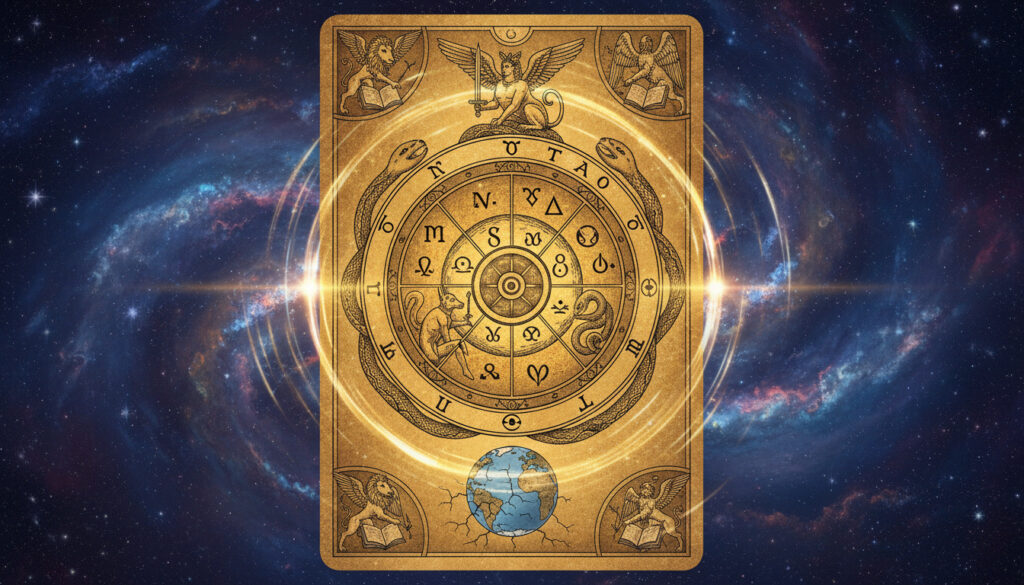
Wheel of Fortune Tarot – Upright and Reversed Meanings
The Wheel of Fortune occupies the tenth position within the Major Arcana, serving as a visual meditation on the inevitability of change and the cyclical nature of fate. This archetype communicates that life’s circumstances rotate continuously—periods of ascent inevitably follow descent—while emphasizing that no individual commands the wheel’s spin. The card draws from ancient concepts of fortune’s unpredictability, standardized through the Rider-Waite-Smith deck of 1909, and carries distinct associations with Jupiter’s expansive, benefic energy.
Practitioners encounter this card when readings address pivotal transitions, karmic reckonings, or moments where external forces override personal control. Its imagery—a turning wheel surrounded by symbolic creatures—functions as a reminder that adaptation proves more viable than resistance when cycles shift. The numerological value of ten, reducing to one, further reinforces themes of completion giving way to new beginnings, embedding the concept of eternal recurrence within a single pictorial frame.
What Does the Wheel of Fortune Tarot Card Mean?
Change, cycles, destiny, good luck
Resistance, bad luck, delays, setbacks
Yes (when upright)
Jupiter
- Inevitable Flux: Change operates as a constant force rather than an occasional disruption, requiring recognition that stability remains temporary.
- Karmic Operation: The card emphasizes reaping rewards or paying dues based on previous actions, connecting present circumstances to past causes.
- Fated Opportunities: Significant openings often arrive through destiny’s intervention rather than purely strategic planning or effort.
- Adaptive Necessity: Success depends on riding the wheel’s momentum rather than attempting to halt its rotation.
- Resistance Costs: Opposition to natural cycles generates stagnation, stress, and missed turning points.
- Fortune’s Temporality: Good times demand acknowledgment of their impermanence to prepare for subsequent shifts.
- Numerological Completion: As the tenth Major Arcana card, it signals the closure of one phase while initiating fresh cycles.
| Attribute | Value |
|---|---|
| Arcana Number | 10 |
| Planetary Association | Jupiter |
| Element | Fire |
| Keywords | Change, fortune, cycles, destiny |
| Numerology | 10 (reduces to 1) |
| Position | Major Arcana |
| Historical Origin | Medieval European tarot traditions |
| Standardization | 1909 (Rider-Waite-Smith deck) |
Sources confirm that upright positions generally indicate good luck, karma, and decisive moments for growth, while reversed appearances suggest setbacks, lack of control, or the need to break negative cycles.
Wheel of Fortune Tarot in Love and Relationships
Upright Positions and Destined Encounters
When the Wheel of Fortune appears upright in relationship spreads, it signals luck in love and the potential for meeting soulmates or karmic partners. The card suggests positive shifts—perhaps a relationship turning toward commitment or the arrival of a destined connection that feels preordained rather than coincidental. This positioning reflects good karma accumulated through previous relational patterns, indicating that current circumstances favor emotional growth and mutual understanding.
Upright appearances often indicate relationships governed by past-life connections or destined encounters that arrive precisely when the wheel turns to one’s favor, rather than through forced effort.
Reversed Indicators and Relational Turbulence
Reversed positions point to turbulence, misunderstandings, or unwanted changes within partnerships. Sources indicate this orientation advises addressing underlying issues directly, allowing time for resolution rather than clinging to control. The reversal warns against resisting necessary changes—such as the natural conclusion of a cycle—encouraging instead a period of reassessment before relational dynamics can stabilize.
Wheel of Fortune Career and Money Interpretation
Professional Turning Points
Career readings featuring the Wheel of Fortune upright indicate significant turning points, including unexpected opportunities such as surprise job offers, bonuses, or rapid professional growth. Interpretations suggest this card marks favorable timing for calculated risks, as external forces currently align to support advancement. The appearance often coincides with moments where years of preparation meet sudden availability of position or recognition. A Fall from Grace illustrates how quickly professional circumstances can shift when external forces intervene.
Financial Cycles and Risk Assessment
Financially, upright positions signal positive shifts or slow, steady growth from patient investments. However, reversed orientations demand caution against gambling or speculative risks, warning instead to expect temporary difficulties or unexpected expenses. Financial interpretations emphasize building safety nets during reversed periods, as the wheel’s downturn remains temporary but requires preparation to weather without significant loss.
Key Symbols and Imagery on the Wheel of Fortune Card
The card’s visual vocabulary draws from medieval iconography standardized in the 1909 Rider-Waite deck. The central wheel itself represents fate’s perpetual motion, while surrounding figures embody different responses to change. Rider-Waite specifics include Hebrew letters and Anubis figures climbing or falling, emphasizing simultaneous ascent and descent depending on one’s position in the cycle.
The winged creatures positioned at the four corners correspond to the evangelists and symbolize the elements or seasons, anchoring the wheel’s chaos within a framework of cosmic order and elemental stability.
Clouds surrounding the wheel specifically represent the unpredictability of fate, reminding observers that while cycles turn inevitably, the specific timing and nature of changes remain beyond precise calculation.
The sphinx often depicted atop the wheel signifies stability amid motion—wisdom that maintains equilibrium regardless of the wheel’s rotation. Meanwhile, serpentine or canine figures descending the wheel’s left side illustrate the consequences of resisting natural cycles, serving as visual warnings against fighting inevitable decline phases.
Wheel of Fortune as a Yes or No Card and Quick Facts
Binary Readings and Clarity
While not explicitly detailed as a definitive binary indicator across all traditions, the upright Wheel of Fortune generally leans toward “yes”—affirming positive change, good luck, and favorable momentum. Conversely, reversed positions typically suggest “no” or “not yet,” indicating delays, bad luck, or the need to wait for more favorable timing before proceeding with the query at hand.
Astrological and Numerological Associations
The card maintains a primary association with Jupiter, the planet governing expansion, abundance, and benefic fortune. Some sources additionally link it to Sagittarius, the zodiac sign characterized by optimism and change, though astrological attributions vary slightly across traditions. Numerologically, ten reduces to one, embedding leadership and new beginnings within the cycle’s completion.
Historical Evolution and Timing Associations
- Early European tarot decks incorporate the Wheel of Fortune motif derived from the medieval Rota Fortunae concept, symbolizing fortune’s unpredictability in feudal societies.
- A.E. Waite and Pamela Colman Smith standardize the Rider-Waite imagery, adding layered symbolic depth including specific Hebrew letters and Egyptian-inspired figures.
- The card maintains relevance across digital interpretations and pop culture references while retaining core cyclical meanings regarding karma and inevitable change.
Established Meanings Versus Interpretive Variations
| Consistently Established | Areas of Uncertainty or Variation |
|---|---|
| Jupiter as primary planetary association | Specific zodiac sign assignments (Sagittarius mentioned in some sources, absent in others) |
| Numerological value of 10 reducing to 1 | Precise timing predictions for specific events (remains unpredictable) |
| Upright/reversed polarity meanings regarding luck and resistance | Health-related interpretations (limited source material available) |
| Core symbolism of sphinx, wheel, and four winged creatures | Personal intuition’s specific role in individual spread positions |
Spiritual and Cultural Background of the Wheel
Spiritually, the Wheel of Fortune teaches acceptance of fate’s cycles and the necessity of surrendering control to larger karmic patterns. The card suggests that growth emerges through adaptation to change rather than rigid maintenance of static conditions. When reversed, it specifically urges breaking negative patterns through deep introspection—examining how resistance to natural cycles creates recurring stagnation.
This philosophical stance connects to broader mythological traditions wherein the goddess Fortuna rotates her wheel regardless of human desire, distributing outcomes arbitrarily yet cyclically. The tarot adaptation transforms this randomness into a karmic framework wherein current positions result from previous actions, creating moral accountability within the mechanism of change.
Expert Interpretations and Historical Sources
The Wheel of Fortune teaches that cycles of change and fate are constant, emphasizing the need to adapt and accept the ups and downs of life while recognizing that resistance only amplifies suffering during inevitable transitions.
Contemporary tarot scholarship drawing from Rider-Waite traditions
Historical documentation traces the card’s visual evolution from medieval woodcuts to the refined symbolism of the Rider-Waite-Smith interpretation, maintaining consistent themes of cyclical destiny while adapting iconographic details to reflect changing cultural understandings of karma and cosmic justice.
Understanding the Wheel of Fortune in Your Reading
The Wheel of Fortune demands recognition that current circumstances—whether favorable or challenging—remain temporary states within larger cycles. Rather than offering definitive predictions, it counsels preparation for change and flexibility when the ground shifts beneath established patterns. How to Make Friends – Research-Backed Strategies for Adults demonstrates how social adaptability mirrors the card’s core message of navigating change through openness rather than resistance.
Frequently Asked Questions
How does Wheel of Fortune tarot timing work?
The card represents unpredictable timing tied to natural cycles or seasons. Upright suggests manifestation nearing; reversed indicates delays requiring patience.
What is the Wheel of Fortune spiritual meaning?
Spiritually, it teaches surrendering control to fate’s cycles and karmic patterns. Reversed positions specifically urge breaking negative cycles through introspection.
How should beginners read Wheel of Fortune in a spread?
Consider position and surrounding cards. Upright generally supports the query’s momentum; reversed advises waiting or reassessing before action.
How does Wheel of Fortune connect to other Major Arcana?
As the 10th card, it bridges the first decade’s completion (cards 1-10) with subsequent spiritual development, particularly connecting to Justice (11) and Hanged Man (12).
What health insights does reversed Wheel of Fortune offer?
Reversed positions hint at potential disruptions. Sources advise prioritizing self-care and positive adjustments during challenging health periods.
More related posts
 Women in STEM Fields: Meaning, Importance, and Inspiring Pioneers
 What Is a Bunion? Causes, Treatment, and Prevention
 Boston Celtics vs Lakers Match Player Stats: Box Scores
 What Does IMO Mean? Texting, Shipping & App Explained
 2026 Hockey Gold Medal: USA Sweeps Canada in OT
 Red Sox vs Milwaukee Brewers Match Player Stats – Box Scores & Series Recap
 Bank Jobs Near Me – Dallas Salaries, Openings and Requirements
 What Is Renters Insurance? Ireland Guide 2025
