Kidney Location in Body: Anatomy, Pain, and Early Signs
That dull ache in your lower back you’ve been wondering about — is it a pulled muscle, or something involving your kidneys? It’s a surprisingly common question, and the answer starts with understanding exactly where those two bean-shaped organs are tucked. Knowing your kidney’s location in the body is the first step to recognizing when something feels off, and this guide walks through the anatomy, the warning signs, and the most common causes of kidney trouble.
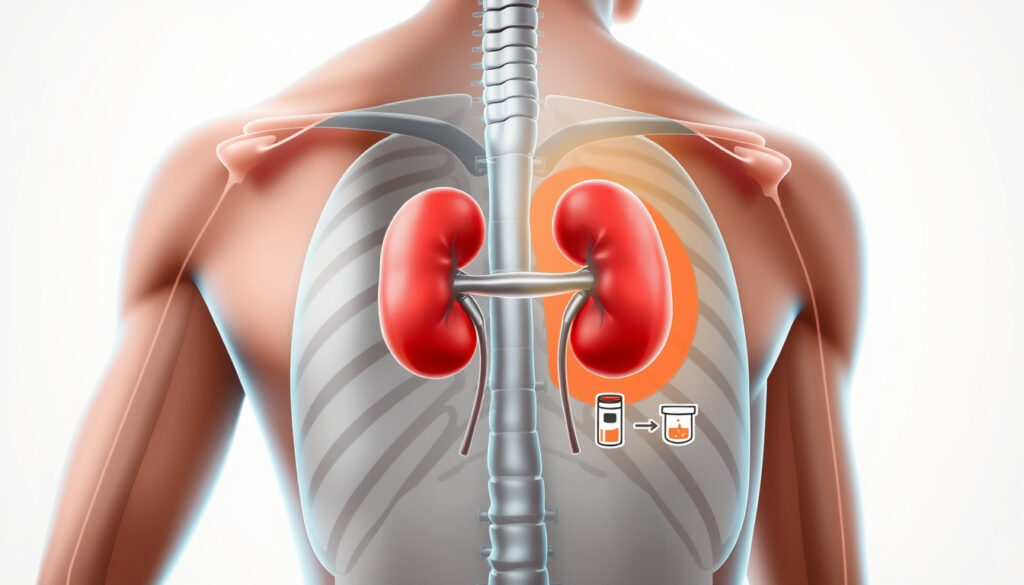
Kidneys are located just below the rib cage: one on each side of the spine, from T12 to L3 vertebrae ·
Each kidney is about the size of a fist: 10-12 cm long, 5-7 cm wide ·
Chronic kidney disease affects 1 in 7 U.S. adults: approximately 37 million people ·
Kidney pain is most often felt in the flank or lower back: can radiate to the abdomen or groin
Quick snapshot
- Two bean-shaped organs below rib cage, each side of spine (Cleveland Clinic)
- Retroperitoneal position behind the abdominal cavity (MedicineNet)
- Usually felt in flank or lower back, deep and persistent (ANCMN)
- May radiate to the abdomen or groin (Cleveland Clinic)
- Foamy or bloody urine, swelling in legs/feet (NICE guidelines)
- Fatigue and nausea as kidney function declines (UCSF Hospital Handbook)
- Diabetes and high blood pressure lead causes of kidney failure (KDIGO)
- Long-term NSAID use increases risk significantly (NICE guidelines)
Four key facts about kidney size, position, and function, one pattern: the organs are compact but remarkably high-throughput.
| Attribute | Value |
|---|---|
| Size | Fist-sized (10-12 cm long, 5-7 cm wide) |
| Spinal level | T12 to L3 vertebrae (MedicineNet) |
| Weight per kidney | 120-170 grams |
| Blood flow per minute | About 1.2 liters |
| Position | Retroperitoneal (behind the abdominal cavity) (Cleveland Clinic) |
| Right kidney vs left | Right sits slightly lower because of the liver (MedicineNet) |
The implication: the kidney’s fixed position makes it a reliable reference point for pain attribution, even before tests confirm the source.
Where are the kidneys located in the body?
Your kidneys sit on either side of your spine, tucked behind your abdominal organs against your back muscles. The Cleveland Clinic describes them as two bean-shaped organs situated just below the rib cage, one on each side of the spine. The upper part of each kidney extends to the level of the 12th thoracic vertebra (T12), and the lower part reaches down to the 3rd lumbar vertebra (L3) — roughly the middle of your lower back.
Because the liver occupies space on the right side of the abdomen, the right kidney sits slightly lower than the left, according to MedicineNet. This asymmetry matters clinically: when a person reports pain on the right side, the kidney’s slightly displaced position can influence how and where the pain is felt.
Kidney position in females vs males
In both sexes, the kidneys occupy the same basic retroperitoneal space behind the abdominal cavity, between the rib cage and the hip bone. However, anatomical landmarks differ:
- In females, the lower ribs generally sit slightly broader, but the kidney’s relationship to the costovertebral angle (the 90-degree angle between the lower rib and spine) is nearly identical.
- In males, the kidneys are positioned within a slightly narrower pelvic inlet, but the spinal-level reference (T12-L3) remains consistent, as confirmed by MedicineNet.
“Your kidneys sit just below your rib cage and in your lower back.”
— Cleveland Clinic
The pattern: regardless of sex, the kidney’s anchor points to the spine and rib cage stay constant, which means location-based pain clues work equally well for both.
Kidney location from the back
If you place your hands on your lower back just below the last rib, you’re close to where the kidneys are positioned. The costovertebral angle — that small depression at the bottom edge of your rib cage next to the spine — is the external landmark clinicians use to check for kidney tenderness. The LKY Urology practice notes that the flank and costovertebral angle are common locations where kidney-related discomfort is noticed.
Because the kidneys are fixed in place behind the abdominal cavity, they don’t shift with body position the way a muscle or bowel loop might. That stability makes location a reliable clue: if pain moves when you change posture, it’s less likely to be renal.
Where would you feel pain from a kidney?
Kidney pain has a distinct signature — and it’s often not where people expect it. The Cleveland Clinic reports that kidney pain is commonly felt under the ribs on one or both sides of the spine, and can radiate to the abdomen, groin, or even the inner thigh. That radiation pattern is a key differentiator from simple back strain.
The sensation itself is typically deep and persistent — a dull ache rather than a sharp, stabbing sensation. The ANCMN notes that kidney pain is more likely felt in the back than the front, and is described as deep rather than superficial. This depth makes sense anatomically: the kidneys are tucked against the back muscles behind the abdominal cavity, so discomfort often travels along those deep nerve pathways.
How to differentiate kidney pain from back pain
- Location: Back pain often centers on the spine or large muscle groups; kidney pain is typically more lateral, in the flank or costovertebral angle, per MedicineNet.
- Radiation: Kidney pain may radiate to the groin or inner thigh; muscle back pain usually stays in the back.
- Quality: Kidney pain is a deep, persistent ache; muscle pain can be sharp or burning following movement.
- Triggers: Back pain often worsens with specific movements or lifting; kidney pain is usually constant regardless of activity.
Studies estimate that up to 40% of patients with kidney stones initially present to urgent care with a back-pain complaint. That misattribution can delay appropriate imaging and treatment by days.
What are the first signs of kidney trouble?
The NICE guideline NG203 on chronic kidney disease (CKD) identifies several early markers that should prompt medical evaluation. Many of these are subtle and easy to overlook, which is exactly why kidney disease is often called a silent condition.
- Changes in urine: Foamy or frothy urine indicates proteinuria; blood (visible or microscopic) may signal glomerular damage, per NICE.
- Swelling: Fluid retention in the ankles, feet, or around the eyes when kidney filtration drops.
- Fatigue and nausea: As waste products accumulate in the blood, the UCSF Hospital Handbook notes that early uremic symptoms include lassitude and loss of appetite.
- High blood pressure: The kidneys regulate blood pressure; rising readings can be both a cause and a consequence of kidney damage, according to KDIGO.
Importantly, NICE recommends that when unexplained proteinuria is detected on a reagent strip, clinicians should test for CKD using eGFRcreatinine and the albumin-to-creatinine ratio (ACR), not just a dipstick. If the initial ACR is between 3 mg/mmol and 70 mg/mmol, NICE says to confirm it with a subsequent early morning sample.
“Persistent invisible haematuria without proteinuria should be followed up annually while it persists.”
— NICE Guideline NG203
When to see a doctor
The PSG Hospitals advice is direct: pain accompanied by fever, body aches, fatigue, painful urination, blood in the urine, nausea, or vomiting are signs that need medical attention — not rest and ibuprofen. For people with diabetes, hypertension, or a family history of kidney disease, even subtle changes in urine appearance should trigger a primary care visit.
Early kidney disease often has no symptoms at all. That means waiting for symptoms is a losing game — the people who feel something are often already in stage 3 or beyond.
How do you check for kidney pain?
If you’re wondering whether your back discomfort is kidney-related, there are self-assessment clues, but the LKY Urology clinic advises that self-palpation is not recommended. Pressing hard on your back near the costovertebral angle can indicate tenderness, but it won’t tell you whether the pain is from a kidney, a muscle, or a spinal issue.
Medical diagnosis follows a structured process:
- Physical exam: The clinician percusses (taps) the costovertebral angle. If that’s painful, it’s a positive sign for kidney involvement.
- Urinalysis: NICE recommends reagent strips to test for haematuria, with further evaluation for results of 1+ or higher. The UCSF Hospital Handbook gives a normal protein excretion threshold of less than 150 mg/day.
- Blood tests: eGFR and creatinine levels measure how well the kidneys filter waste.
- Imaging: Ultrasound is first-line; CT scan or MRI is used for stones, masses, or obstruction.
For those with glomerular disease, KDIGO recommends routine evaluation of urine sediment for erythrocyte morphology and red cell casts. And if proteinuria exceeds 1 g/day with hematuria or reduced GFR, a kidney biopsy is generally recommended.
What destroys the kidneys the most?
Two conditions are responsible for the majority of kidney failure cases worldwide. According to KDIGO‘s clinical practice guidelines, diabetes and hypertension are the leading causes of end-stage renal disease. Together, they account for about 70% of new dialysis cases in the United States.
- Diabetes: High blood sugar damages the small blood vessels in the glomeruli, the kidney’s filtering units. Over years, this leads to protein leakage and declining filtration.
- High blood pressure: Uncontrolled hypertension puts mechanical stress on the kidney’s delicate vasculature, scarring the nephrons.
- Long-term NSAID use: Non-steroidal anti-inflammatory drugs (ibuprofen, naproxen, diclofenac) reduce blood flow to the kidneys and can cause acute kidney injury, especially when taken for months or years without monitoring.
- Dehydration and infections: Repeated UTIs or kidney infections (pyelonephritis) can scar the kidney tissue over time, reducing function.
- Smoking and obesity: Both are independent risk factors that accelerate CKD progression.
“The kidneys are two bean-shaped organs, each about the size of a fist.”
— NIDDK
The NICE guideline is clear: for people with CKD, the targets are blood pressure below 130/80 mmHg and optimized glucose control. The pattern: most kidney damage is cumulative and preventable if caught early.
Confirmed facts vs. what’s unclear
Confirmed facts
- Kidneys are located retroperitoneally behind the abdominal cavity (MedicineNet)
- The right kidney sits slightly lower than the left due to the liver (MedicineNet)
- Kidney pain is most commonly felt in the flank region (Cleveland Clinic)
- NICE recommends urine ACR over PCR for proteinuria detection (NICE guidelines)
What’s unclear
- Exact referral patterns of kidney pain vary among individuals
- Early kidney disease often goes unnoticed until an advanced stage
- Optimal screening intervals for low-risk populations are still debated
static1.squarespace.com, nice.org.uk, pdfs.semanticscholar.org, kdigo.org
Frequently asked questions
Seven of the most common questions about kidney location and pain, answered with the latest clinical guidelines.
Can kidney pain go away on its own?
It depends on the cause. Mild kidney pain from dehydration may resolve with fluids and rest. But pain from a kidney stone, infection, or obstruction typically persists or worsens and needs medical evaluation (PSG Hospitals).
What does kidney pain feel like?
Patients often describe it as a deep, dull ache in the flank or lower back that doesn’t go away with rest or position change. It can be felt on one or both sides, and may radiate to the groin (ANCMN).
Is kidney pain always serious?
Not always — but it requires investigation. Pain from a minor UTI or dehydration can resolve quickly, while the same symptom could signal a stone, infection, or obstruction. The PSG Hospitals warning signs are: fever, blood in urine, nausea, and vomiting.
What should I do if I think I have kidney pain?
Schedule an appointment with a primary care doctor. They will typically order a urinalysis and blood test (creatinine, eGFR) to check kidney function. If you have fever or vomiting, seek urgent care (NICE guidelines).
Are kidney infections painful?
Yes. Pyelonephritis (kidney infection) typically causes significant flank pain, along with fever, chills, nausea, and fatigue. It requires antibiotics and sometimes hospitalization (PSG Hospitals).
How can I tell if my kidney pain is from a stone?
Kidney stone pain (renal colic) is often sudden, severe, and travels from the flank to the groin — the classic “pain that moves.” It’s frequently accompanied by visible or microscopic blood in the urine (UCSF Hospital Handbook).
Where do you press to feel kidneys?
Clinicians press lightly on the costovertebral angle — the 90-degree angle between the 12th rib and the spine. Tenderness there is a clinical sign of possible kidney involvement. Self-palpation is not recommended (LKY Urology).
Related reading: What Does the Prostate Do? Function, Location, & Conditions · Where Is Hiatal Hernia Pain Located on a Woman?
Your kidneys are hardworking organs with a fixed position behind your abdominal cavity, but they’re easily confused with the muscles and spine when pain strikes. The key takeaway is simple: if pain in your flank or lower back feels deep and doesn’t change with movement — and especially if it’s paired with fever, urinary changes, or nausea — it’s time to stop guessing and start testing. For the millions of adults with undiagnosed early kidney disease, skipping self-diagnosis and getting an annual eGFR and ACR test is the most direct path to avoiding advanced-stage kidney failure.
More related posts
 Septic System Repair Near Me: Costs, Lifespan & Grants in Ireland
 Hannah Montana Tour 2026: Status and Rumors
 A Fall from Grace – Meaning, Origin and Examples
 Watch Pride and Prejudice 2005: Streaming & Netflix Guide
 Chinese Research Vessel Detected Alaska – Timeline, Concerns, US Response
 Matthew Lillard Movies and TV Shows: Filmography & Career
 Spider Solitaire: Complete Guide to Rules, Strategy, and Free Play
 How to Fix Slow DNS Lookup: Windows, Mac, Router Fixes
