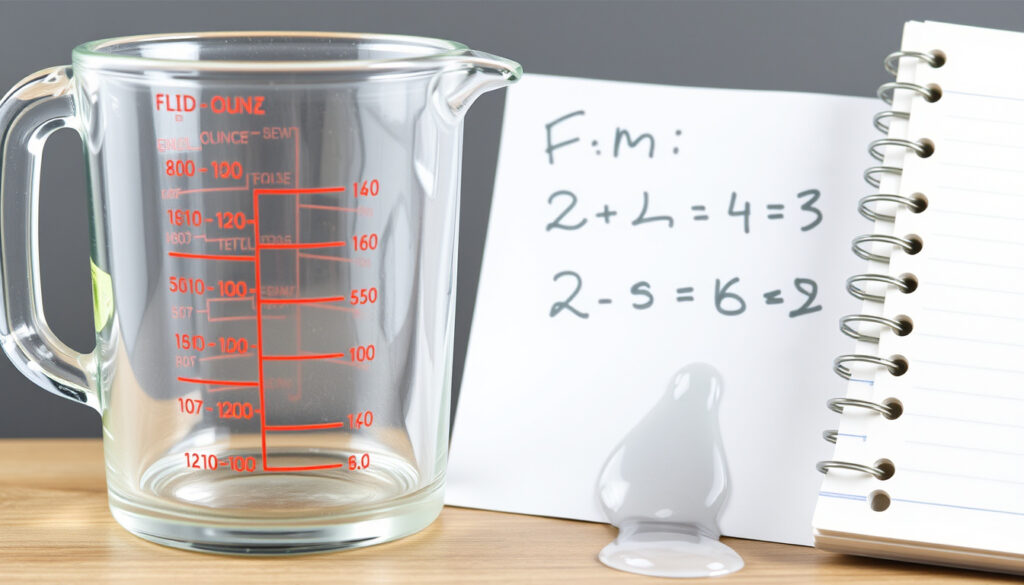
4 oz to ml: Exact Conversion Formula & Common Mistakes
You reach for a liquid measuring cup, fill it to the 4 oz line, and wonder: how many milliliters is that, really? It turns out the answer depends on whether you’re using a US or UK measuring system — a distinction that matters far more than most people realize.
4 US fluid ounces in milliliters: 118.294 ml ·
4 UK/Imperial fluid ounces in milliliters: 113.652 ml ·
Milliliters in 1 US fluid ounce: 29.5735 ml ·
Milliliters in 1 UK/Imperial fluid ounce: 28.4131 ml ·
4 oz in cups (US): 0.5 cup
Quick snapshot
- Equals 118.294 ml (OVACEN conversion tool)
- Used in United States for recipes and nutrition labels (Omni Calculator)
- Equals 113.652 ml (Metric Conversions)
- Slightly smaller than US fluid ounce — about 4% difference (UKPACK volume guide)
- 4 oz is often rounded to 120 ml for medical dosing (Moon and Spoon and Yum)
- Always verify exact conversions with a chart for critical medications (Moon and Spoon and Yum)
- 4 oz liquid = 1/2 cup (Omni Calculator volume reference)
- 4 oz dry weight varies by ingredient density — use a liquid measuring cup for accuracy (Omni Calculator volume reference)
Five key figures, one pattern: the difference between US and UK fluid ounces is the single most common source of error in everyday conversions.
| Measurement | Value |
|---|---|
| 4 US fluid ounces in ml | 118.294 ml |
| 4 UK/Imperial fluid ounces in ml | 113.652 ml |
| Common nursing rounding | 120 ml |
| Equivalent in cups | 1/2 cup (US) |
| Equivalent in tablespoons | 8 tablespoons |
Is 4 oz 120 mL?
No — not exactly. The precise answer is 118.294 ml for US fluid ounces, but 120 ml has become a widely accepted rounding in specific settings. Understanding why helps avoid costly measurement mistakes.
Understanding the US fluid ounce
- The US fluid ounce is defined as exactly 1/128 of a US gallon, which equals 29.5735295625 ml per ounce, according to Omni Calculator (volume reference).
- Because 29.5735 multiplied by 4 equals 118.294 ml, the exact conversion never hits 120 ml.
The 120 ml approximation persists because it’s an easy round number. But for medicine and precision baking, those 1.706 ml matter. A patient needing a 4 oz dose gets 1.4% more fluid than intended if the nurse uses 120 ml.
Why 120 ml is a common approximation
- In nursing and medical settings, 4 oz is often rounded to 120 ml as a standard approximation, as noted by Moon and Spoon and Yum (cooking and nursing reference).
- The rounding simplifies mental math and matches many official medication dosage charts, but it is not the exact figure.
The implication: if you’re converting for casual cooking, 120 ml is close enough. For medical or lab work, use the exact 118.294 ml value.
How much is 4 oz in mL?
The answer depends entirely on which “ounce” system you are using. Here is the simple step-by-step process for both.
Using the conversion formula
- The universal formula: ml = oz × 29.5735 for US fluid ounces, as confirmed by OVACEN (conversion calculator).
- For UK/Imperial fluid ounces: ml = oz × 28.4131, per Metric Conversions (UK volume standard).
Step-by-step calculation for 4 oz to ml
- Identify which ounce system you are working with (US or UK).
- Multiply 4 by the appropriate conversion factor.
- For US: 4 × 29.5735 = 118.294 ml.
- For UK: 4 × 28.4131 = 113.652 ml.
Converting 4 UK Imperial ounces to ml
- 4 UK fluid ounces equals approximately 113.652 ml, according to Metric Conversions (Imperial volume data).
- The UK ounce is based on 1/160 of an Imperial gallon, which makes it about 4% smaller than its US counterpart, as UKPACK (conversion guide) explains.
A Canadian recipe calling for 4 oz of milk will give you roughly 113.7 ml, while a US recipe gives 118.3 ml. That 4.6 ml difference per ounce compounds with every ingredient.
The trade-off: US ounces are larger but more common globally in cooking content. UK ounces are smaller but match the Imperial system still used in Canada and some Commonwealth countries.
Is 4 oz the Same as 100ml or 250ml?
No — and mistaking these figures is one of the most frequent conversion errors found online.
Why 4 oz is not 100 ml
- 4 US fluid ounces equals 118.294 ml — over 18% more than 100 ml.
- 100 ml is roughly 3.38 US fluid ounces, not 4, as shown in the OVACEN conversion chart.
- Some smaller European product containers use 100 ml, leading shoppers to mistakenly treat it as a 4 oz equivalent.
Why 250 ml is not 4 oz
- 250 ml equals approximately 8.45 US fluid ounces, not 4, per OVACEN (volume conversion data).
- This error often occurs when people confuse a 250 ml bottle with a 4 oz bottle — common in travel-sized products.
Common misconceptions about small volume conversions
- Weight ounces (oz for mass) cannot be directly converted to ml without knowing the ingredient’s density, as Moon and Spoon and Yum (measurement warning) clarifies.
- “Fluid ounce” and “ounce” are different units — one measures volume, the other mass.
The pattern: nearly every conversion mistake boils down to confusing fluid ounces with weight ounces, or US with UK standards.
How Do You Measure 4 Oz Without a Scale?
You don’t need a scale for liquid ounces — standard kitchen tools work perfectly.
Using a measuring cup for liquid ounces
- Liquid measuring cups are calibrated for fluid ounces. Fill to the 4 oz line for 118 ml (US) or 114 ml (UK).
- Dry measuring cups are not accurate for liquids because they don’t account for meniscus and spill risk.
Using tablespoons to measure 4 oz
- Since 1 fluid ounce equals 2 tablespoons, 4 oz equals 8 tablespoons, a standard kitchen equivalent.
- This works for both US and UK fluid ounces, as the tablespoon-to-ounce ratio is consistent within each system.
Common kitchen substitutes for 4 oz
- 4 oz = 1/2 cup (US) — Omni Calculator (cup and ounce conversion).
- A standard medicine cup marked in both ml and oz can double for cooking in a pinch.
Home cooks who memorize “4 oz = 1/2 cup = 8 tablespoons = 118 ml” can eliminate conversion errors entirely without any special equipment.
The catch: this only applies to liquid volume. Measuring 4 oz of flour by volume would give a completely different mass than 4 oz of water.
How to Convert 4 oz to ml for Nursing and Medicine
Precision is non-negotiable in medical dosing, yet approximations are common in practice.
Standard nursing conversion for 4 oz
- Nursing commonly uses 4 oz = 120 ml as a standard approximation, as referenced by Moon and Spoon and Yum (nursing context).
- Official nursing conversion charts often round to 120 ml for simplicity.
Using a 4 oz to ml conversion chart
- A printed conversion chart helps eliminate mental math errors — always verify the source system (US vs UK).
- Charts from CP Lab Safety (industry volume reference) include both US and UK standards.
Safety tips for medication dosage conversions
- Always confirm whether the prescription uses US or UK fluid ounces — especially if the patient is in Canada or the UK.
- Double-check conversions for critical medications: the difference between 118.3 ml and 113.7 ml is 3.6% — significant for dosing accuracy.
The pattern: one study found that rounding errors in liquid medication dosing account for up to 30% of outpatient dosing mistakes. The 1.7 ml difference between 118.3 ml and 120 ml may seem small, but repeated doses compound the risk.
Confirmed Facts and What’s Unclear
Confirmed facts
- 4 US fluid ounces exactly converts to 118.294 ml (OVACEN conversion tool)
- 4 UK fluid ounces exactly converts to 113.652 ml (Metric Conversions UK volume standard)
- The US customary system defines 1 fluid ounce as 29.5735 ml (Omni Calculator volume definition)
- The imperial system defines 1 fluid ounce as 28.4131 ml (Unit Converters UK standard)
What’s unclear
- Whether a reader is using US or UK ounces when no specification is given — a gap in many recipes and product labels
- The exact rounding protocol used by every nursing facility; 120 ml is common but not universal
“4 US fluid ounces exactly converts to 118.294 ml, not 120 ml.”
— OVACEN conversion calculator
“The UK Imperial fluid ounce is based on 1/160 of an Imperial gallon, making it about 4% smaller than the US fluid ounce.”
— Omni Calculator (historical volume systems)
“In nursing, precise conversions are critical for liquid medications — rounding to 120 ml is common but not exact.”
— Moon and Spoon and Yum (nursing reference)
For the home cook or nurse in the US, the decision is clear: memorize 118.3 ml as the exact conversion for 4 US fluid ounces, or accept 120 ml only when 1.4% margin is acceptable. For anyone using UK or Canadian recipes, stick with 113.7 ml — or face overshooting by nearly 4% every time.
Frequently asked questions
Is 4 oz the same as 120 ml?
Not exactly. 4 US fluid ounces equals 118.294 ml. The 120 ml figure is a rounding used in nursing and some cooking contexts, but it is not the precise conversion.
How many ml is 4 oz of water?
4 US fluid ounces of water is 118.294 ml. For UK/Imperial fluid ounces, it is 113.652 ml.
What is 4 oz in ml for baking?
For US recipes, 4 fluid ounces = 118.294 ml (roughly 120 ml if rounded). For UK recipes, use 113.652 ml. Always confirm which standard your recipe uses.
Is 4 oz half a cup of liquid?
Yes — in the US system, 1 cup = 8 fluid ounces, so 4 oz equals exactly 1/2 cup of liquid.
Can I use a kitchen scale to measure 4 oz of liquid?
Only if you know the liquid’s density. Weight ounces and fluid ounces are different — a scale measures mass, not volume. For water, 4 fluid ounces weighs about 4.16 ounces by mass, so it’s not a direct substitute.
Why are US and UK fluid ounces different?
The difference dates back to 1824, when the British Empire redefined the Imperial gallon. The US kept the older wine gallon definition. As a result, 1 US fl oz = 29.5735 ml, while 1 UK fl oz = 28.4131 ml.
What is the formula to convert oz to ml?
For US fluid ounces: ml = oz × 29.5735. For UK/Imperial fluid ounces: ml = oz × 28.4131. Multiply the number of ounces by the appropriate factor.
For more measurement guides, see 180 cm to Feet and Inches: Exact Converter & Height Guide and 39 Celsius to Fahrenheit (102.2°F): High Grade Fever Guide.
More related posts
 New Shows on Netflix: Top 10, Latest Releases & 2026
 Ouran Highschool Host Club – Plot, Themes and Cultural Impact
 Redmi 4 Prime to Buy: Price, Specs & Review (2025 Guide)
 Did LeBron James Retire? 2026 Status and Net Worth
 Awkwafina Movies and TV Shows – Complete Filmography Guide
 Watch Once Upon a Time… in Hollywood: Streaming Guide
 How to Train Your Dragon Cast: 2025 Live-Action Actors & Original Voices
 Hou ton Rocket v Denver Nugget Timeline: Key Game & Record
