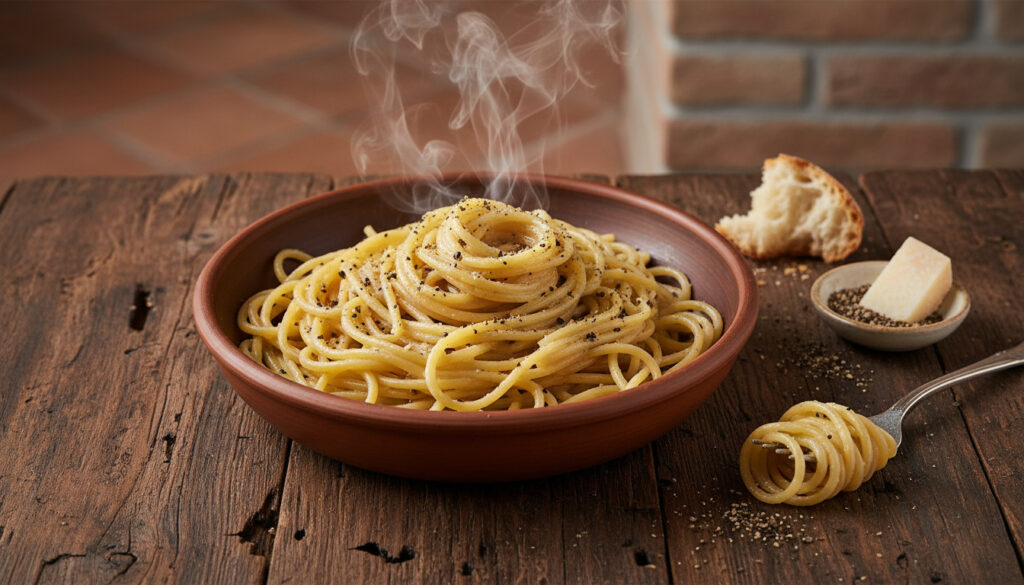
Cacio e Pepe Recipe – Authentic Roman Pasta Guide
Cacio e pepe represents the pinnacle of Roman culinary minimalism. This deceptively simple pasta dish, whose name literally translates to “cheese and pepper,” relies on precise technique rather than complex ingredients to achieve its signature creamy texture without a single drop of cream.
Despite containing only three core components—aged Pecorino Romano, freshly cracked black pepper, and pasta—the recipe challenges even experienced line cooks. The transformation occurs through emulsification, where starch-rich pasta water binds with the cheese’s proteins and fats to create a sauce of remarkable silkiness.
Understanding the science behind this classic reveals why Roman shepherds carried these ingredients centuries ago, and why the dish remains one of the capital’s “big four” pastas alongside carbonara, amatriciana, and gricia.
What Is Cacio e Pepe?
- Starchy pasta water creates the emulsion that binds the sauce
- Freshly cracked black pepper provides essential heat and aromatic oils
- Authentic preparations contain no cream, butter, or eggs
- The quality of aged Pecorino Romano determines final texture
- Precise temperature control prevents protein seizure and clumping
- Recognized as one of Rome’s four canonical pasta dishes
| Attribute | Specification |
|---|---|
| Servings | 2–4 |
| Preparation | 5 minutes |
| Cooking Time | 10–15 minutes |
| Calories | ~500–600 per serving |
| Dietary Classification | Vegetarian |
| Skill Requirement | Intermediate technique |
The dish emerged from the practical needs of Roman shepherds who required portable, shelf-stable provisions. They carried aged Pecorino and peppercorns into the countryside, combining them with pasta to create a sustaining meal. Historically, cacio e pepe evolved from pasta alla gricia, a precursor that included cured pork before tomatoes arrived in Italy. The recipe gained widespread recognition in Roman trattorias during the mid-20th century, eventually achieving global prominence through culinary ambassadors like Anthony Bourdain, according to Urban Farmie and Tales of Ambrosia.
Cacio e Pepe Ingredients and Tools
The Essential Trio
Authenticity demands specificity. The cheese must be DOP-certified Pecorino Romano from Lazio or Sardinia, aged sufficiently to develop sharpness while retaining meltability. Pre-grated varieties contain anti-caking agents that guarantee clumping, rendering them unsuitable. For pepper, whole black peppercorns freshly ground—preferably Sarawak or Rimbàs varieties—deliver the volatile oils essential for fragrance and heat.
Pasta selection affects sauce adhesion. Traditional Roman versions favor tonnarelli (square-shaped spaghetti), bucatini (hollow thick strands), or high-quality spaghetti. These sturdy shapes withstand the vigorous tossing required for emulsification. As noted by Christina’s Cucina, some contemporary recipes incorporate extra virgin olive oil or Parmigiano-Reggiano to enhance creaminess, though purists reject these additions as departures from the canonical form.
Equipment Considerations
A shallow pot proves superior to deep boiling vessels, as less water produces starchier cooking liquid critical for sauce stability. A large skillet accommodates the final tossing phase, while a microplane or fine grater prepares the cheese for rapid melting. A mortar and pestle allows precise control over pepper coarseness.
How to Make Authentic Cacio e Pepe: Step-by-Step
Preparation Phase
Finely grate 100–250 grams of Pecorino Romano using the smallest holes available. Grind 1–2 tablespoons of black peppercorns, adjusting quantity based on heat tolerance. Fill a wide pot with just enough water to cover the pasta—approximately 2–3 liters rather than the standard 5–6—to maximize starch concentration.
Execution
Boil 400 grams of pasta in lightly salted water, removing it precisely two minutes before reaching al dente texture. Reserve the cooking liquid. Meanwhile, toast the ground pepper in a dry skillet over high heat for approximately 30 seconds until fragrant, then add ⅓ to ½ cup of starchy pasta water and reduce slightly, as detailed by An Italian in My Kitchen.
Create the slurry off-heat: combine the grated cheese with ⅓ to ½ cup of hot (not boiling) pasta water in a separate bowl, stirring vigorously until achieving a smooth, cream-like consistency. This critical step prevents the proteins from seizing when exposed to direct high temperatures.
Drain the pasta, preserving additional cooking water. Transfer noodles to the skillet containing the pepper-water mixture over medium-high heat. Pour in the cheese slurry and toss continuously for approximately one minute, adding reserved pasta water incrementally until the sauce thickens and coats each strand. Serve immediately, finishing with additional cheese and cracked pepper.
Why Your Cacio e Pepe Sauce Breaks (and How to Fix It)
The Chemistry of Clumping
Sauce separation occurs when cheese proteins encounter excessive heat, causing them to seize into rubbery clumps rather than dispersing smoothly. Low-starch water exacerbates this problem by failing to provide the hydrocolloid suspension necessary for emulsification. Pre-grated cheese compounds the issue through cellulose additives that repel moisture.
Always combine cheese with pasta water off-heat. Direct exposure to boiling temperatures or high-flame skillets causes immediate protein denaturation and grainy texture.
Restoration Methods
When faced with a broken sauce, remove the pan from heat immediately. Add 2–3 tablespoons of reserved starchy pasta water and agitate vigorously to re-emulsify. The risottare technique—treating the pasta like risotto by adding liquid gradually while stirring constantly—prevents separation before it occurs, according to Pina Bresciani.
Starch molecules from the pasta water act as emulsifiers, binding fat and water phases into a stable colloid similar to mayonnaise. Aged Pecorino’s reduced moisture content facilitates this integration without separation.
Quality DOP Pecorino exhibits superior melting characteristics compared to domestic alternatives. If clumping persists despite technique adjustments, the cheese quality likely represents the limiting factor, as observed in professional kitchen demonstrations.
Tips, Variations, and Pairings for Cacio e Pepe
Sourcing and Selection
Authentic preparation begins with ingredient procurement. DOP Pecorino Romano commands premium prices—often exceeding $20 per pound—reflecting traditional production methods and aging protocols. Italian pasta brands like De Cecco provide the protein structure necessary for releasing adequate starch during cooking.
Freshly grinding peppercorns immediately before cooking preserves volatile aromatic compounds that dissipate within hours of grinding. Similarly, purchasing cheese in blocks rather than pre-grated form eliminates cellulose anti-caking agents that interfere with smooth melting.
Dietary Adaptations
Vegan versions substitute the Pecorino with cashew-based emulsions or nutritional yeast blended with starch water, though these create distinct flavor profiles rather than faithful replicas. For gluten-free requirements, corn or rice-based spaghetti alternatives work satisfactorily, though texture varies from traditional wheat pasta, based on guidance from Urban Farmie.
Beverage Accompaniments
The dish’s saline intensity and pepper heat find balance in crisp Italian whites such as Frascati or the Pecorino variety from Abruzzo. Light-bodied reds including Chianti complement the pepper without overwhelming the palate. Heavy, oak-aged wines compete unfavorably with the cheese’s sharpness.
The Evolution from Shepherd Food to Global Icon
- Shepherds combine portable Pecorino and pepper with pasta as field sustenance
- Formalized as a trattoria staple in Rome’s culinary districts
- Viral global popularity driven by celebrity chef endorsement and social media
This trajectory reflects broader patterns in Italian gastronomy, where humble regional preparations achieve international recognition through their fundamental deliciousness despite—or because of—their simplicity.
Canonical Rules vs. Modern Interpretations
| Established Convention | Ongoing Debate |
|---|---|
| No cream, eggs, or butter in authentic versions | Addition of extra virgin olive oil to facilitate emulsification |
| DOP Pecorino Romano as primary cheese | Blending ratios when incorporating Parmigiano-Reggiano |
| Starchy pasta water essential for sauce formation | Precise measurements for pepper quantities |
| Medium-high heat maximum during final combination | Optimal duration for toasting peppercorns |
The Cultural Significance of Roman Pasta Simplicity
Cacio e pepe occupies a unique position within the quattro paste of Rome, representing the endpoint of a culinary evolution that includes its pork-enriched ancestor, gricia. The dish demonstrates the Roman culinary philosophy that exceptional ingredients require minimal manipulation—technique serves to amplify rather than mask natural flavors.
The emulsification process central to the recipe mirrors other gastronomic transformations where mechanical action and molecular bonding create textures impossible through simple mixing. Understanding these chemical reactions, much like comprehending What Does Pepto Bismol Do – Uses, How It Works, Side Effects, involves appreciating how distinct compounds interact under specific conditions to produce desired outcomes.
Perspectives from Professional Kitchens
“The pasta water is not just an ingredient; it is the binding agent that transforms cheese and pepper into a cohesive sauce. Without adequate starch content, you simply have flavored noodles.”
— Culinary tradition documented by Eatalian Cooks
“This dish punishes impatience. The temptation to increase heat for faster melting guarantees failure. Low and slow incorporation off the flame separates amateur attempts from professional execution.”
— Technique analysis from Tales of Ambrosia
Achieving Mastery Through Practice
Perfecting cacio e pepe requires internalizing the interaction between heat, starch, and protein. Success demands quality ingredients treated with technical respect—freshly grated cheese, coarsely cracked pepper, and aggressively starchy water combined with patience rather than haste. Like developing competencies outlined in How to Make Friends – Research-Backed Strategies for Adults, the process rewards consistent practice and attention to fundamental principles over shortcuts.
Frequently Asked Questions
How many calories are in a typical serving of cacio e pepe?
Approximately 500–600 calories per 100-gram dry pasta serving, containing 20–30 grams protein, 20–25 grams fat, and 70 grams carbohydrates. The high sodium content (1000–1500mg) derives primarily from the aged Pecorino.
Can cacio e pepe be prepared using gluten-free pasta?
Yes. Substitute traditional wheat spaghetti with corn or rice-based gluten-free alternatives. Maintain the shallow-water cooking method to ensure adequate starch release for emulsification, though final texture may differ slightly from traditional versions.
Why does my cheese sauce become grainy instead of creamy?
Graininess indicates protein seizure from excessive heat or insufficient starch. Remove the pan from heat, add additional starchy pasta water, and toss vigorously. Prevent future occurrences by creating the cheese slurry off-heat before introducing it to the pasta.
Is adding cream or butter considered acceptable?
Purists reject cream and butter as non-canonical additions that mask the technique required for proper emulsification. While some modern home cooks use these to stabilize the sauce, their inclusion produces a different dish rather than authentic cacio e pepe.
What vegan alternatives work for the cheese component?
Cashew-based cheese sauces or nutritional yeast blended with starch water provide approximate flavor profiles, though they cannot replicate the specific protein structures of aged Pecorino. These adaptations prioritize nutty, salty, and umami characteristics while acknowledging the result diverges from tradition.
Which pasta shapes work best beyond spaghetti?
Tonnarelli (square-cut spaghetti) and bucatini (hollow thick strands) represent traditional Roman choices that provide superior sauce adhesion due to their surface area and structural rigidity. Linguine and fettuccine serve as acceptable alternatives.
How should leftovers be stored and reheated?
The dish reaches optimal quality immediately upon preparation. Storing leftovers risks sauce breakdown as the emulsion destabilizes. If necessary, refrigerate for up to 24 hours and reheat gently with additional pasta water to attempt re-emulsification, though texture will degrade.
More related posts
 New Orleans Pelicans vs Timberwolves Match Player Stats (2025-26)
 Star Wars: The Rise of Skywalker – Box Office & Reception
 Where to Watch MobLand: Paramount+, Prime Video, Apple TV
 How to Translate English to Arabic: Complete Guide
 University of West Florida: Rankings, Tuition, Admissions & Athletics
 Los Angeles Rams vs Philadelphia Eagles: Predictions, Recaps
 Bible Verse About Strength: 10 Powerful Verses for Hard Times
 LA Clippers vs Dallas Mavericks Player Stats (Mar 21, 2026)
