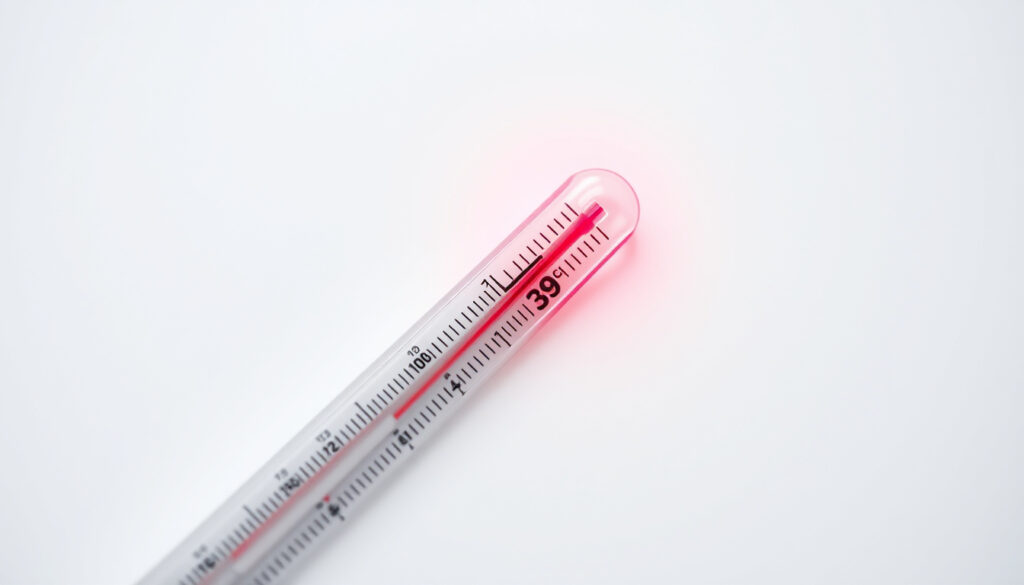
39 Celsius to Fahrenheit (102.2°F): High Grade Fever Guide
That 39°C reading on your thermometer means 102.2°F — a number that lands squarely in high-grade fever territory for adults. Most medical authorities flag 39°C as a threshold where monitoring intensifies and the question of whether to seek care becomes urgent.
39°C equals: 102.2°F · Normal body temperature: 37°C (98.6°F) · Fever threshold adults: 38°C (100.4°F)
Quick snapshot
- 39°C converts to exactly 102.2°F (Celsius to Fahrenheit Converter)
- Adult fever starts at 100.4°F (38°C) per Mayo Clinic
- High-grade fever in adults begins at 102.2°F (39°C) (Tylenol)
- Hospital admission thresholds vary by symptom severity rather than temperature alone (Medical News Today)
- Elderly-specific fever cutoffs lack precise quantification in primary literature (Medical News Today)
- Modern NCIT thresholds published 2022 in Frontiers in Public Health
- Regional pediatric fever management variations documented since 2013 (Frontiers in Public Health)
- Fever lasting beyond 3-5 days warrants professional evaluation per OSF HealthCare
- Seek emergency care if fever exceeds 103°F (39.4°C) with severe symptoms (OSF HealthCare)
Fever thresholds vary by body location and measurement method, as shown in this comparison table.
| Measurement method | Fever threshold | Authority |
|---|---|---|
| Oral / Rectal / Temporal | 100.4°F (38°C) | Mayo Clinic |
| Armpit | 99°F (37.2°C) | Mayo Clinic |
| High-grade fever (adult) | >102.2°F (>39°C) | Tylenol |
| High fever (adult) | >103°F (>39.4°C) | Cleveland Clinic |
| Normal body temperature | 97.7–99.5°F (36.5–37.5°C) | Mayo Clinic |
Is 39 C in F a fever?
Yes — a reading of 39°C (102.2°F) qualifies as a fever for adults, placing you in the high-grade fever range that most medical authorities treat with caution. Mayo Clinic defines adult fever as any temperature at or above 100.4°F (38°C), which means 39°C sits comfortably above that marker. According to Tylenol, moderate fever spans 100.4°F to 102.2°F, with high-grade fever kicking in above 102.2°F — so 39°C lands right at the boundary between moderate and high-grade fever. Medical News Today recommends seeking immediate help when an adult’s temperature reaches 102.4°F (39.1°C) or higher.
Fever thresholds for adults
- Low-grade fever: 100.4°F to 102.2°F (38°C to 39°C)
- High-grade fever: Above 102.2°F (39°C) per Tylenol
- Medical attention warranted: Above 103°F (39.4°C) per Cleveland Clinic
Fever in children and babies
Children and infants have different fever thresholds than adults. For babies under three months, any rectal temperature of 100.4°F (38°C) or higher warrants immediate medical attention, according to Mayo Clinic first-aid guidelines. For older children, thresholds align more closely with adult guidelines, though pediatricians in French and Italian-speaking regions reportedly use lower temperature cutoffs before initiating treatment compared to German-speaking regions, according to a PMC study on regional variations in pediatric fever management.
What is 40 degrees Celsius in Fahrenheit?
Forty degrees Celsius equals 104°F exactly. The conversion follows a straightforward formula: multiply the Celsius value by 9/5 and add 32. So for 40°C: (40 × 9/5) + 32 = (40 × 1.8) + 32 = 72 + 32 = 104°F. This puts 40°C squarely in dangerous territory — Cleveland Clinic classifies temperatures above 103°F (39.4°C) as high fever that warrants contacting a healthcare provider. At 40°C, you are past the threshold where heatstroke becomes a genuine risk, especially in environmental exposure scenarios.
Exact conversion
The math is clean: 40°C converts to exactly 104°F. This matters for medical documentation and for anyone tracking temperature changes across different measurement scales. Celsius to Fahrenheit Converter confirms this is a whole-number conversion, making it useful as a reference point for other nearby values like 39°C (102.2°F) and 38°C (100.4°F).
Health risks at 40°C
- High fever classification per Cleveland Clinic
- Risk of febrile seizures in children increases significantly
- Heatstroke risk in environmental exposure scenarios
- Fevers lasting beyond 3-5 days at this level require evaluation per OSF HealthCare
Adults at 40°C face a temperature level where medical monitoring becomes essential, not optional. The difference between 39°C and 40°C is only 1.8°F, but it crosses the line into territory where healthcare providers start asking serious questions about underlying causes.
Is 39 degrees Celsius hot or cold?
For the human body, 39°C is unequivocally hot — it’s nearly 2°C above normal body temperature. Mayo Clinic notes that normal body temperature averages 98.6°F (37°C), with a normal range spanning 97.7°F to 99.5°F. A reading of 39°C puts you roughly 2°F above the high end of normal, which is why your body responds with the shivering, fatigue, and general malaise that characterize fever. In environmental terms, 39°C would be considered extreme heat for most outdoor activities, equivalent to about 102°F — uncomfortable weather conditions that most people would describe as hot.
Compared to body temperature
Your body maintains a tight temperature range through a process called thermoregulation. When pathogens trigger an immune response, your hypothalamic set point rises, making a 39°C internal reading feel cold on the outside even though your body is generating heat intentionally. Medical News Today notes that body temperature varies throughout the day based on activity level, time of day, and age — so a morning reading of 39°C might feel different from an evening reading at the same temperature.
Environmental vs body temp
There’s a crucial distinction between ambient temperature and body temperature. When weather forecasters report 39°C outside, they mean air temperature — the kind that makes you seek air conditioning. When your body reads 39°C internally, it means your core temperature has risen due to illness, exercise in extreme heat, or other physiological stress. The health implications are completely different: hot weather causes discomfort, while a 39°C body temperature indicates your immune system is actively fighting something.
Confusing ambient heat with fever symptoms leads to wrong self-treatment decisions. If you’ve been outdoors in 39°C heat and then check your temperature, give yourself 20 minutes to cool down before interpreting the reading, because your body may not have had time to return to normal baseline.
Should I go to the hospital with a 39.5 fever?
A fever of 39.5°C (103.1°F) sits at the threshold where most healthcare providers recommend contacting them, though emergency care depends on accompanying symptoms. Medical News Today specifically recommends seeking immediate help for temperatures of 102.4°F (39.1°C) or higher in adults, which means 39.5°C has crossed that line. However, Cleveland Clinic clarifies that fevers below 103°F are typically not dangerous — so 39.5°C is in a gray zone where professional guidance becomes essential rather than optional.
When to seek emergency care
- Temperature at or above 103°F (39.4°C) with severe symptoms per Cleveland Clinic
- Fever accompanied by confusion, severe headache, or difficulty breathing
- Fever persisting beyond 3-5 days regardless of exact temperature per OSF HealthCare
- Any fever above 100.4°F in infants under three months per Mayo Clinic
First aid steps
Mayo Clinic recommends a straightforward approach while deciding whether to seek care: stay hydrated with water or electrolyte solutions, rest in a cool environment, and consider acetaminophen or ibuprofen if the fever is causing discomfort. Do not give aspirin to children or teenagers due to Reye’s syndrome risk. For adults, sponging with lukewarm — not cold — water can help reduce temperature gradually without triggering shivering, which would counterproductive raise body temperature further.
Adults: call emergency services if 39.5°C fever comes with seizures, confusion, severe headache, stiff neck, or difficulty breathing. Children: do not hesitate — temperatures at this level in kids under two years warrant pediatric evaluation same-day.
Is 38.5 C sick?
A temperature of 38.5°C (101.3°F) is technically a fever — any reading at or above 100.4°F (38°C) qualifies per Mayo Clinic — but whether it makes you “sick” depends on context. Tylenol classifies 38.5°C as falling within the low-to-moderate fever range for adults, sitting comfortably below the 102.2°F (39°C) boundary for high-grade fever. For most healthy adults, a 38.5°C fever from a viral infection will resolve on its own within a few days with rest and hydration. The fever itself is a symptom, not a diagnosis — your body is doing exactly what it’s supposed to do when fighting pathogens.
Fever definitions
Medical definitions vary slightly by measurement method. According to Mayo Clinic, oral, rectal, and temporal readings consider 100.4°F (38°C) or higher as fever, while armpit measurements flag 99°F (37.2°C) or higher. LA County Public Health aligns with CDC standards at 38.0°C (100.4°F) for general screening purposes. This means a 38.5°C reading would clearly qualify as fever regardless of measurement location.
Symptoms to watch
- Body aches, chills, and fatigue commonly accompany fevers in the 38.5°C range
- Dehydration risk increases — drink fluids proactively per Mayo Clinic
- Monitor for symptom progression: worsening cough, chest pain, or rash
- Fever-reducing medication appropriate if discomfort interferes with rest
How to convert 39 Celsius to Fahrenheit
The conversion from 39°C to Fahrenheit uses a two-step formula that works for any Celsius value. Multiply by 9, divide by 5, then add 32. Working through 39°C specifically: (39 × 9) ÷ 5 + 32 = 351 ÷ 5 + 32 = 70.2 + 32 = 102.2°F. This result is exact — there is no rounding involved because 39 is divisible by the factors in the conversion formula.
- Step 1: Multiply 39 by 9 → 351
- Step 2: Divide 351 by 5 → 70.2
- Step 3: Add 32 → 102.2°F
The formula follows from the different freezing and boiling points of each scale: water freezes at 32°F and boils at 212°F (a 180-degree span), while in Celsius it freezes at 0°C and boils at 100°C (a 100-degree span). The ratio 180/100 simplifies to 9/5, which is why that fraction appears in every Celsius-to-Fahrenheit conversion.
Every 1°C increase equals a 1.8°F increase. This means a 5°C swing translates to exactly 9°F — a handy shortcut when estimating without a calculator. For 39°C, you can work from the known 40°C benchmark (104°F) and subtract 1.8°F to arrive at 102.2°F.
Understanding fever grades and when they matter
Fever classification helps both patients and healthcare providers communicate risk levels effectively. Tylenol establishes a practical four-tier framework: low-grade fever spans 100.4°F to 102.2°F (38°C to 39°C), while high-grade fever begins above 102.2°F. Cleveland Clinic takes a more conservative approach, noting that fevers below 103°F are typically not dangerous but those above 103°F warrant contacting a healthcare provider. The slight variation between sources reflects genuine clinical judgment calls rather than contradictory data.
Upsides
- Fever is a productive immune response that helps the body fight infection
- Most fevers resolve without medical intervention in healthy adults
- Temperature monitoring provides clear feedback on illness progression
Downsides
- Fever increases metabolic demand and fluid loss
- High fevers can trigger febrile seizures in susceptible individuals
- Fever masks other symptoms, making diagnosis harder without professional input
What medical authorities say
“In adults, fevers less than 103 degrees F (39.4 degrees C) typically aren’t dangerous.”
— Cleveland Clinic (Medical Institution)
“A high-grade fever for an adult is any temperature above 102.2°F.”
— Tylenol (Pharmaceutical Guide)
“Generally, doctors consider any body temperature over 100.4°F (38°C) a fever.”
— Medical News Today (Health Publication)
Summary
The conversion 39°C equals exactly 102.2°F — a number that places you firmly in high-grade fever territory for adults, according to Tylenol. While Cleveland Clinic notes fevers below 103°F are typically not dangerous, the threshold varies by measurement method and individual health factors. Mayo Clinic confirms the standard adult fever threshold at 100.4°F (38°C), making 39°C nearly 2°F above the medical baseline. For readers tracking a fever at home, the practical takeaway is clear: 39°C means rest, hydration, and close monitoring — with a phone call to your healthcare provider if the fever persists beyond 72 hours or accompanies severe symptoms like confusion or difficulty breathing.
Related reading: 39 Degrees Celsius to Fahrenheit: 102.2°F Fever Guide
Clinical thresholds align with the 39°C conversion guide, which details 39°C as precisely 102.2°F and a high-grade fever indicator for adults.
Frequently asked questions
Is 40°C a normal body temperature?
No. Normal adult body temperature averages 98.6°F (37°C) per Mayo Clinic, with a normal range of 97.7°F to 99.5°F. A reading of 40°C (104°F) indicates severe fever requiring medical attention.
Is 40 degrees Celsius survivable?
Body temperature of 40°C (104°F) is survivable in the short term during fever, but sustained exposure risks heatstroke and organ damage. Cleveland Clinic classifies 103°F+ fevers as requiring medical contact, and fevers this high should not be left untreated for extended periods.
Why are negative 40 Celsius and Fahrenheit the same?
At -40°, the Celsius and Fahrenheit scales intersect because the formulas converge: plugging -40 into °F = (°C × 9/5) + 32 gives -40 = (-40 × 9/5) + 32, which simplifies correctly. This is the only temperature where both scales read identically.
At what temperature does the human body shut down?
The human body begins experiencing heatstroke effects when core temperature exceeds 40°C (104°F), with cell damage accelerating above 45°C (113°F). Mayo Clinic recommends emergency care for fevers above 103°F (39.4°C).
What is the 50 50 50 rule for hypothermia?
The 50-50-50 rule refers to hypothermia risk estimates: approximately 50% of hypothermia deaths occur in air temperatures between 30-50°F (roughly -1 to 10°C), and alcohol is implicated in about 50% of cases. Consult Mayo Clinic emergency guidelines for specific cold-exposure protocols.
What is 38 Celsius to Fahrenheit?
38°C equals 100.4°F exactly — the standard medical threshold for adult fever per Mayo Clinic. This is also the CDC fever cutoff used for screening purposes per LA County Public Health.
Is 39 Celsius a fever in babies?
Yes, 39°C qualifies as fever for babies older than three months, though infants under three months require evaluation at any fever above 100.4°F (38°C) per Mayo Clinic. Contact your pediatrician if a baby this age shows 39°C fever, especially if accompanied by lethargy, poor feeding, or rash.
What is 39 Celsius in Kelvin?
39°C converts to 312.15 Kelvin using the formula K = °C + 273.15. Kelvin starts at absolute zero (-273.15°C), so this places 39°C about 12% of the way from freezing to boiling on an absolute scale.
More related posts
 Cast of The Terminal List: Season 1, 2 & Dark Wolf Prequel
 Watch Once Upon a Time… in Hollywood: Streaming Guide
 Sydney Sweeney Red Carpet: Age, Height & Style Evolution
 Trader Joe’s Soup Dumplings: Cooking, Reviews & Nutrition
 Amazon Customer Service Number – US, UK & Ireland Info
 Steal a Brainrot Discord: Servers, Invites & Join Guide
 Blue Lock Season 2: Release, Complaints, Season 3 News
 Demon Slayer Infinity Castle Movie Release Date: 2025, 2027, 2029
