Tesla LFP Battery Factory Nevada: Location, Ramp-Up & Details
Tesla’s Gigafactory Nevada in Sparks has always been synonymous with battery production at scale. Now the company’s quietly adding a new chapter to that story: an LFP cell factory that’s ramping up right alongside the existing Panasonic line. If you’ve been wondering what’s actually happening at that Sparks address, here’s what the record shows.
Location: Sparks, Nevada · Partner: CATL · Production Type: LFP cells · Status: Early-stage ramp · Facility: Gigafactory Nevada
Quick snapshot
- Gigafactory Nevada in Sparks (east of Reno) Electrive confirms plant location
- LFP cell production now in early-stage ramp (Basenor) Basenor ramp report
- CATL-derived equipment, ~10 GWh/year initial capacity Battery Tech Online process report
- Exact production volumes to date
- Full ramp timeline to named capacity
- Precise investment cost for Nevada LFP specifically
- Construction begins 2014 → Grand opening July 29, 2016 Wikipedia Gigafactory Nevada timeline
- April 2026: Early-stage LFP ramp confirmed Basenor ramp report
- Michigan factory targets 2027 launch, 50 GWh capacity Tesla Hubs Michigan factory details
- Nevada LFP cells destined primarily for Megapacks Basenor Megapack focus report
- Broader domestic supply chain buildout underway (Basenor Megapack focus report)
- Pack assembly remains the current bottleneck (Basenor Megapack focus report)
Six key facts about Tesla’s Nevada battery operation, sourced from a mix of industry publications and official records.
| Field | Value |
|---|---|
| Operator | Tesla, Inc. |
| Location | Sparks, Nevada (east of Reno) |
| Battery Type | Lithium Iron Phosphate (LFP) |
| Partner | CATL |
| Status | Ramping production |
| Products | Batteries, powertrains, motors |
Where is the Tesla battery factory in Nevada?
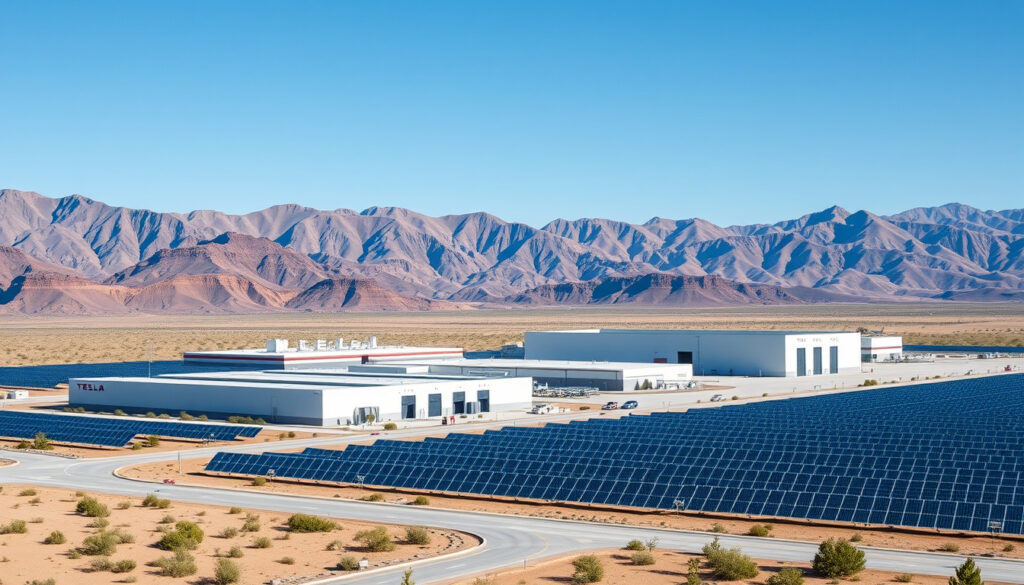
Tesla’s LFP cell factory sits in Sparks, Nevada—adjacent to the main Gigafactory Nevada complex that dominates the landscape east of Reno. The Electrive confirms the plant location in Sparks, placing it directly alongside the existing facility that already produces 2170 and 4680 cells with Panasonic. This adjacency lets Tesla share infrastructure—utilities, logistics corridors, and workforce—between the older cylindrical-cell lines and the new prismatic LFP operation.
Gigafactory Nevada itself covers more land area than any other Tesla factory globally. Wikipedia’s Gigafactory Nevada entry notes it started Powerwall production in January 2016 and held its grand opening on July 29, 2016. The expansion into dedicated LFP production marks a deliberate pivot: where the Panasonic partnership focuses on high-energy-density cells for EVs, the new LFP line targets stationary storage where cycle life and thermal stability matter more than raw energy density.
Gigafactory Nevada location details
The Sparks campus stretches across industrial-zoned land that Tesla has accumulated since 2014. The new LFP facility occupies a distinct section within the broader complex, using CATL-derived equipment delivered and installed under a supply-only arrangement that keeps CATL’s direct involvement off the books in terms of U.S. political optics.
Sparks NV address
Tesla has not published a standalone address for the LFP cell facility separate from the main Gigafactory Nevada address. The parent facility’s location is well-documented in public filings and confirmed across multiple sources including Tesla’s official Gigafactory Nevada page.
The pattern is consistent: Tesla builds adjacent to existing infrastructure rather than greenfield, and the Sparks LFP line follows that script exactly.
The Nevada LFP factory targets roughly 10 GWh/year of initial capacity—dwarfed by the planned 50 GWh Michigan plant—but it’s already producing while Michigan won’t come online until 2027. That head start matters for utility procurement cycles.
Does Tesla manufacture LFP batteries?
Yes. Tesla confirmed in April 2026 that the LFP cell factory at Gigafactory Nevada entered early-stage ramp-up, Basenor reports. This marks the first time Tesla has brought LFP cell production in-house on American soil. The cells rolling out of the Nevada line are intended primarily for Megapacks—the utility-scale energy storage systems that have become a core part of Tesla’s product portfolio alongside vehicles.
Tesla also operates cathode and lithium refining operations in Texas, with the Corpus Christi lithium refinery reaching full capacity in February 2026. Combined with the Nevada LFP ramp, Tesla is threading together a domestic supply chain for LFP that reduces dependence on Chinese battery imports. Battery Tech Online notes the Nevada facility adopts a wet coating process, aligning with industry standards largely developed by Chinese manufacturers—which makes sense given the CATL equipment sourcing.
Current production status
Basenor’s reporting places the Nevada LFP operation in “early-stage ramp” as of April 2026. Tesla itself confirmed ramp-up across Nevada LFP, Texas cathode, and Texas lithium facilities, though it flagged pack assembly as the current bottleneck limiting output from these cells into finished Megapacks. Early reports from 2024 had suggested operations wouldn’t begin until 2025—Tesla appears to have beaten that estimate.
Partnership with CATL
Tesla bears full ownership and control of the Nevada LFP plant and absorbs all capital costs. Teslarati reports that CATL’s role is strictly limited to supplying and setting up equipment—a structure designed to sidestep political scrutiny over Chinese involvement in U.S. manufacturing. CEO Elon Musk publicly thanked suppliers like CATL during Tesla’s Q4 FY 2023 earnings call, framing the relationship as collaborative rather than competitive.
The implication: Tesla gains manufacturing capability while keeping Chinese capital and labor physically absent from U.S. operations.
CATL provides equipment only—a deliberate choice to keep Chinese capital and labor off U.S. soil while still leveraging CATL’s proven manufacturing process. This structure lets Tesla claim domestic production without triggering tariff exposure.
Does Tesla make its own LFP batteries?
Partially. Tesla owns the Nevada facility outright and runs day-to-day operations, but the production technology comes from CATL. Battery Industry confirmed CATL is supplying equipment for Tesla’s Nevada factory in comments attributed to CATL itself. Tesla engineers and workers execute the manufacturing; CATL provides the blueprint and the machinery.
This model—buying equipment from a technology licensor rather than contracting full production—parallels Tesla’s approach with the 4680 cell program, where the company designed its own cell architecture but relied on external equipment suppliers. For LFP, Tesla skipped the R&D investment by adopting CATL’s wet coating process, which the Battery Tech Online coverage describes as an established standard in Chinese LFP production.
In-house vs supplier production
Tesla’s ownership gives it control over hiring, production scheduling, and eventual cell pricing—but it also means Tesla absorbs the capital risk. If the Nevada line performs as designed, Tesla gains a domestic LFP source insulated from import tariffs and supply chain disruptions. If it underperforms, Tesla has no third-party supplier to share the loss.
Wet coating process
The wet coating approach refers to how electrode slurries—containing LFP active material, binders, and conductive additives—are applied to current collectors. This method dominates Chinese LFP production and is well-suited to prismatic cell formats that fit efficiently into Megapack enclosures. Tesla’s adoption of this process means it can source slurry components from multiple suppliers rather than being locked to a single CATL formulation.
What this means: Tesla gains LFP cell production capability without building know-how from scratch—borrowing CATL’s process reduces time-to-production but cements a technology dependency that Tesla will need to address eventually.
By adopting CATL’s wet coating without licensing fees, Tesla cuts its LFP development timeline but inherits a process dependency that could complicate future supplier diversification.
Why did Tesla build the Gigafactory in Nevada?
Tesla selected Nevada for the original Gigafactory in 2014 for two converging reasons: state incentives and geographic proximity to Panasonic, which was already producing cylindrical cells for Tesla at its facilities in Japan. The Wikipedia Gigafactory Nevada entry documents the timeline—construction began in 2014, Powerwall production moved to the site in October 2015, and the grand opening followed on July 29, 2016. Tesla committed $3.6 billion to Giga Nevada for the 100 GWh 4680 cell factory and Semi factory.
Today, the addition of the LFP line reflects a new calculus: geopolitical pressure to reduce reliance on Chinese batteries, growing demand for Megapacks in utility and commercial markets, and the strategic value of making LFP cells domestically where they can feed directly into pack assembly without import friction.
Historical reasons
The 2014 site selection prefigured the current battery nationalism wave by nearly a decade. Nevada offered a willing government partner, land at competitive rates, and a workforce with manufacturing experience from the state’s gaming-equipment sector. Panasonic’s willingness to co-locate cemented the choice—the Japanese company brought cylindrical cell expertise while Tesla built the integration with its vehicle programs.
Expansion for batteries
The expansion into LFP production leverages infrastructure Tesla has spent a decade building in Sparks. Utilities, water rights, transmission connections, and trained personnel are already in place—scaling LFP production costs less per GWh than building greenfield. The Nevada expansion is part of broader Giga Nevada growth adding roughly 3,000 jobs.
The pattern: Tesla picked Nevada for Panasonic’s proximity in 2014 and now benefits from that decade of infrastructure investment for an entirely different battery chemistry.
Gigafactory Nevada produced its 5 millionth drive unit on June 5, 2024, and hit 10 million cumulative units by July 31, 2024—milestones that underscore the scale Tesla has already achieved at the Sparks site. These volumes validate the infrastructure bet Nevada made in 2014.
Who is the largest producer of LFP batteries?
CATL dominates global LFP production by a significant margin, controlling the largest share of worldwide LFP output and operating manufacturing capacity that dwarfs any Western competitor. Electrive’s coverage of the Nevada announcement frames CATL’s involvement as deliberately limited—equipment supply only—to navigate U.S. political concerns about Chinese industrial presence in critical supply chains.
Tesla’s entry into LFP production, even at 10 GWh/year initially, signals that the company wants a seat at the table in a chemistry it previously sourced entirely from CATL and BYD. The Michigan factory with LG Energy Solution targets 50 GWh/year—five times Nevada’s capacity—but won’t produce cells until 2027. By then, Nevada should be well past early-stage ramp.
Top manufacturers
CATL leads global LFP production, followed by BYD and a cluster of smaller Chinese producers. In the U.S., no manufacturer currently matches CATL’s LFP scale. The Tesla-LG Michigan joint venture, once operational, will be the largest U.S.-based LFP factory at 50 GWh/year—but it will still be a fraction of CATL’s global capacity.
Tesla’s role
Tesla is simultaneously a customer and a competitor to CATL—a relationship CEO Elon Musk has called out publicly as non-adversarial. Tesla sources LFP cells from CATL for some vehicles sold internationally while building its own LFP capacity for domestic energy storage. The dual-track strategy gives Tesla negotiating leverage and supply security without requiring it to abandon its CATL relationship entirely.
The catch: Even at 10 GWh/year, Nevada won’t displace CATL’s scale. Tesla’s domestic LFP production is strategically symbolic—it’s proof of concept for U.S.-based LFP manufacturing—but it’s not a threat to CATL’s market position.
Timeline
Seven milestones trace the arc from the original Gigafactory Nevada decision through the current LFP ramp-up.
| Date | Event |
|---|---|
| July 2016 | Powerwall production moved to Giga Nevada |
| July 29, 2016 | Gigafactory Nevada grand opening |
| June 5, 2024 | 5 millionth drive unit produced |
| July 31, 2024 | 10 millionth Tesla drive unit cumulative |
| March 2026 | Texas lithium refinery reaches full capacity |
| March 2026 | Nevada LFP early-stage ramp-up begins |
| March 2026 | Michigan LFP factory confirmed by government |
Confirmed and Unclear
Confirmed facts
- Location in Sparks, Nevada
- CATL partnership (equipment only)
- Gigafactory Nevada expansion underway
- Initial capacity ~10 GWh/year
- LFP cells targeted at Megapacks
- Wet coating process adopted
What’s still unclear
- Exact production volumes to date
- Full ramp timeline to named capacity
- Precise investment cost for Nevada LFP specifically
- Current operational output as of May 2026
- Workforce or job creation specifics
- Expansion plans beyond initial 10 GWh
Expert Voices
Tesla is not competing with its suppliers when it comes to battery production. Instead, the EV maker is very appreciative of our suppliers, one of which is CATL.
— Elon Musk, Tesla CEO, Q4 FY 2023 earnings call
American-made cells will power Tesla’s Megapack 3 energy storage systems produced in Houston, creating a robust domestic battery supply chain.
— U.S. Department of the Interior, March 2026 announcement on Michigan factory
Summary
Tesla’s LFP battery factory in Nevada represents a methodical move toward supply chain independence—for energy storage specifically, not yet for vehicles. The 10 GWh/year Sparks facility is ramping up in April 2026, making it the first American-made LFP cells from a domestic manufacturer at any scale. The technology borrows from CATL, the output feeds Megapacks, and the political structure deliberately minimizes Chinese fingerprints on U.S. soil. For utilities planning large-scale storage projects: the window for locking in long-term Megapack supply from a domestic factory just opened, and it’s worth watching how quickly Nevada scales beyond its early-stage output.
Related reading: Gigafactory Nevada
Frequently asked questions
What is the Tesla LFP battery factory in Nevada?
It’s a dedicated Lithium Iron Phosphate cell production line within Gigafactory Nevada in Sparks, using CATL-derived equipment to produce cells primarily for Megapack energy storage systems.
When did LFP production start at Gigafactory Nevada?
Early-stage ramp-up began in April 2026, according to Basenor’s reporting. Initial operations were originally expected in 2025, so the startup came in ahead of early projections.
What technology does Tesla use for LFP batteries?
Tesla adopted the wet coating process for its Nevada LFP production—a standard method in Chinese LFP manufacturing that applies electrode slurries in liquid form before drying, well-suited to prismatic cell formats.
How does LFP differ from lithium-ion in Tesla vehicles?
LFP offers superior cycle life and thermal stability but lower energy density compared to NMC and NCA chemistries used in Tesla’s long-range vehicles. That trade-off makes LFP ideal for stationary storage where depth of discharge and longevity matter more than weight and volume.
Is CATL involved in Tesla’s Nevada factory?
CATL’s role is limited to supplying and installing manufacturing equipment. Tesla owns and operates the facility, bearing all capital costs and controlling production decisions.
What other products are made at Gigafactory Nevada?
The broader facility produces battery packs, drivetrains, motors, Powerwall units, and cylindrical 2170 and 4680 cells in partnership with Panasonic.
Where exactly is Tesla’s Sparks factory?
The Gigafactory Nevada campus sits in Sparks, Nevada, east of downtown Reno. Tesla has not published a separate address for the LFP cell facility distinct from the main Gigafactory address.
More related posts
 Amex Platinum Annual Fee – 2025 Breakdown and Value Guide
 Carpal Tunnel Syndrome: Causes, Symptoms & Treatment
 When Does Gen Z End? Birth Years & Age Range
 Bible Verse About Strength: 10 Powerful Verses for Hard Times
 Call of Duty Mobile – Everything You Need in 2024
 When Did the Pope Die? Pope Francis Death Date and Details
 What Are the Symptoms of COVID-19? Current Signs and Duration
 Sydney Sweeney Red Carpet: Age, Height & Style Evolution
