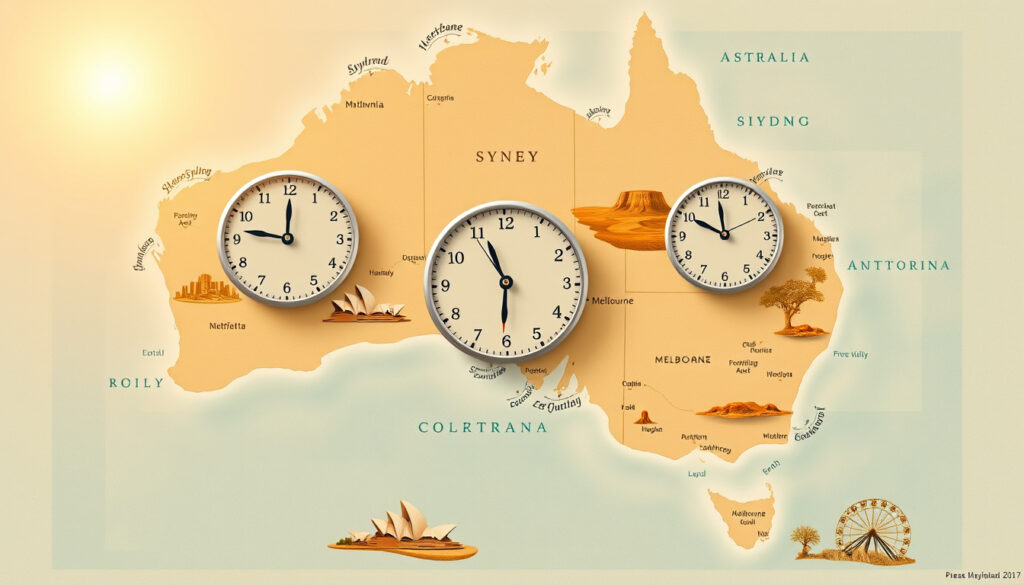
What Time Is It in Australia Now? Sydney, Melbourne, Perth Times
If you need to call someone in Australia right now, the answer isn’t simple. The country stretches across three standard time zones, and that’s before daylight saving throws two more into the mix. One moment you’re working with Sydney time, the next you’re calculating whether Perth is two hours behind or three. Here’s what you need to know to get the timing right.
Main Time Zones: AEST, ACST, AWST · Sydney Time Zone: AEST (UTC+10) · Perth Time Zone: AWST (UTC+8) · DST Observance: Varies by state
Quick snapshot
- Australia has three standard UTC offsets: AWST (UTC+8), ACST (UTC+9:30), AEST (UTC+10) (Tourism Australia)
- AEST runs 2 hours ahead of AWST year-round (Savvy Time)
- Exact minute and second for any given moment varies by zone and refresh rate
- Live clock data requires real-time tools beyond static sources
- DST ends Sunday April 5, 2026 (SBS News)
- DST resumes Sunday October 4, 2026 (Savvy Time)
- Australia transitions between three and five time zones depending on DST season
- Real-time converters needed for exact minute-level accuracy
The key facts table consolidates Australia’s time zone landscape for quick reference.
| Label | Value |
|---|---|
| Time Zones | 3 primary (AEST, ACST, AWST) |
| UTC Offsets | +8 to +10 |
| DST States | NSW, VIC, TAS, SA |
| No DST | QLD, NT, WA |
| Australia_time_zones_count_standard | 3 |
| DST 2026 Start | 2026-10-04 |
| DST 2026 End | 2026-04-05 |
| AEST-AWST Difference | 2 hours |
What time is it in Australia now, AM or PM?
Whether your contact in Australia is starting their morning or winding down depends entirely on which city you’re reaching. Australia spans roughly 3,000 kilometres from east to west, and that geographic spread translates into significant time differences. At 5 PM on a Tuesday in New York, it’s already early the next morning on Australia’s east coast.
Sydney and Melbourne sit on the country’s eastern rim, sharing Australian Eastern Standard Time (AEST, UTC+10:00) during the non-daylight-saving months (Savvy Time). When daylight saving is active, these cities shift to AEDT (UTC+11:00). In contrast, Perth on the opposite coast keeps Australian Western Standard Time (AWST, UTC+8:00) year-round, never adjusting for longer summer evenings (Wikipedia Time in Australia). Between these extremes sits the Northern Territory and South Australia, each with their own offset.
If you’re scheduling a call, 11am–5pm Sydney time (9am–3pm Perth time) works as a reasonable overlap window for business hours (Savvy Time). Outside those hours, you’re asking someone to adjust their day significantly.
Current time across zones
Three distinct time zones govern Australia’s standard time: AWST at UTC+8, ACST at UTC+9:30, and AEST at UTC+10 (Wikipedia Time in Australia). When daylight saving kicks in for southeastern states, two additional zones appear—AEDT at UTC+11:00 and ACDT at UTC+10:30 for South Australia (Wikipedia DST in Australia). This means Australia operates with either three or five time zones depending on the season.
AM/PM in major cities
For someone in London trying to reach Sydney on a Wednesday afternoon at 3 PM GMT, the east coast city is already in the evening hours—around 2 AM the following day. Perth, meanwhile, sits at midnight. That 14-hour gap between London and Sydney during standard time stretches to 15 hours when daylight saving runs in both regions.
The pattern flips for Americans. A New York caller at 9 AM EST connects with Sydney around 11 PM that same night (or midnight during daylight saving). Perth, however, lands in the 7–9 PM range, making early-evening calls feasible if the east coast requires inconveniently late scheduling.
Upsides
- Consistent year-round time in Western Australia and Queensland
- Clear daylight hours for most outdoor activities across the continent
- Established conversion formulas between all major zones
Downsides
- Crossing thousands of kilometres may require multiple watch adjustments
- Not all states observe daylight saving, creating complexity for callers
- Eucla and Broken Hill use non-standard offsets, complicating regional calculations
What time is it in Sydney and Melbourne?
Sydney and Melbourne maintain identical time zones year-round—AEST during standard months, AEDT when daylight saving is active. The two cities never diverge from each other, sitting roughly 900 kilometres apart but sharing the same clock. This consistency means there’s no need to calculate a gap between Australia’s two largest urban centres (Mathspace educational resource).
Both cities shifted to the first Sunday in October for DST start dates beginning in 2008–09, synchronising their clocks for the first time in years (Wikipedia DST in Australia). Victoria had previously started DST a week earlier than New South Wales, creating brief mismatches that confused interstate travellers and businesses. That history is gone.
Sydney time details
Sydney operates on AEST (UTC+10:00) through autumn and winter. When daylight saving activates—typically the first Sunday in October at 2:00 AM—the city shifts to AEDT (UTC+11:00) (NSW Government official site). The NSW state government confirms this has been the practice since 1971, with DST ending on the first Sunday in April at 3:00 AM AEDT. In 2026, that transition falls on April 5.
Melbourne time details
Melbourne follows the same rhythm as Sydney, governed by Victoria’s daylight saving policy. Tasmania also observes DST on the same schedule, using AEDT during summer months (Reserve Bank of Australia schedule). The result is a contiguous southeastern time zone stretching from Hobart through Melbourne to Sydney—millions of people sharing one clock for most of the year.
Comparison table
Three cities illustrate Australia’s east-west time divide most clearly.
| City | Standard Zone | DST Zone | DST Active? | UTC Offset |
|---|---|---|---|---|
| Sydney | AEST | AEDT | Yes (Oct–Apr) | +10 / +11 |
| Melbourne | AEST | AEDT | Yes (Oct–Apr) | +10 / +11 |
| Perth | AWST | None | No | +8 |
| Brisbane | AEST | None | No | +10 |
The pattern shows Brisbane aligns with Sydney and Melbourne only when daylight saving is inactive—creating a one-hour gap during summer months.
When DST ends on April 5, 2026, Australia effectively loses two of its five time zones and drops back to three. Sydney, Melbourne, and Brisbane briefly align on the same offset, though Perth remains two hours behind. The Reserve Bank of Australia confirms the April 5 transition date, making it a reliable anchor for business scheduling.
What time is it in Australia Perth?
Perth keeps things simple. The city runs on AWST (UTC+8:00) throughout the year, with no adjustment for daylight saving. Western Australia has not observed DST since the practice was discontinued in the state, leaving Perth isolated from the time shifts that govern the east coast (Wikipedia Time in Australia).
That isolation creates the most pronounced time gap in the country. When Sydney and Melbourne are at their busiest—mid-morning to late afternoon—Perth is still grinding through the early hours. The two-hour difference means a 9 AM call from London’s financial district reaches Perth just after 5 PM, leaving a narrow window before the city’s evening winds down.
Perth AWST details
AWST covers the entire western third of the continent, including the mining communities of the Pilbara, the port city of Fremantle, and the wineries of Margaret River. The zone is remarkably stable—no spring forward, no autumn back. Tourists and business travellers arriving from the eastern states often find themselves adjusting to a time that feels pleasantly relaxed compared to the frenetic pace of Sydney.
Difference from east coast
AEST is 2 hours ahead of AWST, and this gap never closes (Savvy Time converter tool). During Sydney’s summer daylight saving, the difference stretches to 3 hours. For international callers, that matters: a New York executive scheduling a 2 PM conference call faces vastly different options depending on whether they’re reaching Perth or Sydney. Perth limits you to early-morning slots in New York; Sydney allows afternoon scheduling but puts you deep into their evening.
Perth’s year-round consistency is a genuine advantage for long-term scheduling. No surprises, no recalculating twice a year. But that same consistency means Western Australia misses out on the longer summer evenings that eastern staters enjoy—and the time difference from major international markets never shrinks.
What time is it in Australia Brisbane?
Brisbane sits on AEST (UTC+10:00), placing it in the same time zone as Sydney and Melbourne during standard months. Unlike those cities, however, Queensland does not observe daylight saving. Brisbane stays locked on AEST year-round, creating a growing gap from its southern neighbours as summer progresses.
The practical result: in October, when clocks spring forward in Sydney and Melbourne, Brisbane suddenly falls an hour behind. That gap persists through summer and into early April, when DST ends and all three cities realign. The state’s government has consistently rejected daylight saving proposals, citing the relatively modest gains for a subtropical region where summer evenings rarely linger past 9 PM.
Brisbane AEST details
Queensland stretches from the tropical north to the subtropical south, and Brisbane anchors its southeastern corner. The city shares AEST with Sydney in winter, but from October to early April, Sydney runs one hour ahead. This creates a peculiar situation for callers: a 3 PM New York call reaches Sydney at 6 AM the next day but doesn’t hit Brisbane until 5 AM.
Queensland specifics
Northern Queensland cities including Townsville and Cairns also sit on AEST year-round. The state’s vast north-south geography means Townsville experiences sunrise roughly 40 minutes before Brisbane despite sharing the same time zone. For callers focused on business hours, the real constraint isn’t geographic—it’s the persistent one-hour gap from Sydney during daylight saving season (Wikipedia DST in Australia).
The catch: Queensland’s refusal to observe DST creates a predictable annual misalignment with its southern neighbours, forcing businesses to adjust scheduling twice a year when dealing with interstate contacts.
How many hours ahead is Australia right now?
Australia’s position ahead of Coordinated Universal Time reflects its location on the western side of the International Date Line. The country’s eastern cities (AEST) sit 10–11 hours ahead of UTC, while Perth lags at 8 hours ahead. These aren’t arbitrary numbers—they determine every international call, every video conference, and every broadcast schedule that spans the continent.
For UK callers, the gap ranges from 9 hours (Perth) to 11 hours (Sydney/Melbourne during summer daylight saving) to 10 hours (during standard time). The variation comes from the UK observing GMT in winter and BST in summer, while Australia adjusts its own DST schedule independently. Americans face a larger spread: 13–17 hours depending on which Australian city and which American time zone you’re comparing.
Vs UK
London at noon GMT connects with Sydney at 10 PM (or 11 PM during Australian summer) and Perth at 8 PM (constant year-round). The Australian High Commission notes these relationships matter for trade, diplomacy, and the roughly one million Britons who visit Australia annually. A 30-minute video call requires scheduling for late evening UK time—or very early morning Australian time.
Vs US
New York at 9 AM EST reaches Sydney around midnight (or 1 AM during daylight saving). Los Angeles at 9 AM PST connects with Perth in the early morning hours (around 1 AM) or Sydney in the late night (around 2 AM). The 14–17 hour gaps mean that urgent calls often require one party to sacrifice their evening or early morning. Australia’s proximity to Asian markets—Singapore sits just 4 hours behind Perth—creates natural business hour overlaps that the US simply cannot match.
When daylight saving ends, Australia effectively loses two of its five time zones — SBS News national broadcaster (National broadcaster reporting on DST transitions)
Clocks are moved forward by 1 hour to 3am, giving you more daylight in the evening — NSW Government official site (Official state resource on DST mechanics)
Sydney runs ahead of Perth by about three hours, while sharing its zone with Melbourne, as Sydney and Melbourne time zones confirm for seamless planning.
Frequently asked questions
Is Australia 12 hours ahead or behind?
Australia’s offset from most Western countries varies. From the UK, Australia is 9–11 hours ahead depending on the city and season. From the US east coast, the gap is typically 14–16 hours. Australia is never 12 hours exactly from standard UK or US time zones.
What Does AM and PM Stand For?
AM means “ante meridiem” (before midday) and covers midnight to 11:59 AM. PM means “post meridiem” (after midday) and covers noon to 11:59 PM. In Australia, 12-hour format is standard for everyday use, though digital displays often show 24-hour time.
How many hours ahead is Australia right now?
Eastern Australia runs 10–11 hours ahead of UTC. Perth is 8 hours ahead. From New York (EST/EDT), eastern Australia is 14–16 hours ahead. From London (GMT/BST), the range is 9–11 hours.
Is it AM, morning or night in Australia?
That depends entirely on when you’re checking and which city you’re interested in. Sydney and Melbourne are behind Asian markets but ahead of European and American ones. At 8 PM London time, it’s early morning in Sydney—around 6 AM. At 3 PM New York time, Sydney is past midnight.
What’s the right time in Australia right now?
For accurate current times, use a live converter like Savvy Time or 24 Time Zones (Savvy Time; 24 Time Zones). Static articles cannot provide minute-level accuracy as time moves continuously.
Time in Australia now?
Australia spans three standard time zones. The east coast (Sydney, Melbourne, Brisbane) uses AEST. The centre (Adelaide, Darwin) uses ACST. The west (Perth) uses AWST. Daylight saving adds two more zones from October to April.
For international businesses, the bottom line is straightforward: Australia rewards those who plan ahead. The time gap from North America and Europe is substantial, but it is also predictable. Perth’s stubborn consistency gives schedulers one less variable to manage. Sydney and Melbourne’s shared DST observance simplifies east-coast coordination. Brisbane’s lack of daylight saving creates a one-hour advantage in winter and a one-hour disadvantage in summer—but it is a known, constant disadvantage that never surprises.
More related posts
 Call of Duty Mobile – Everything You Need in 2024
 Figure Skating Milano Cortina 2026: Schedule, Participants, Tickets
 How Many Mission Impossible Movies Are There
 Is Rice Gluten Free? All Varieties & Risks Explained
 What Is Renewable Energy – Definition, Types, Benefits
 Hughes Federal Credit Union: Phone, Address, Auto Loan & More
 Night Agent Season 3 Cast: Who’s Returning and Who’s New
 Brave New World movie: Reviews, box office & MCU connections
