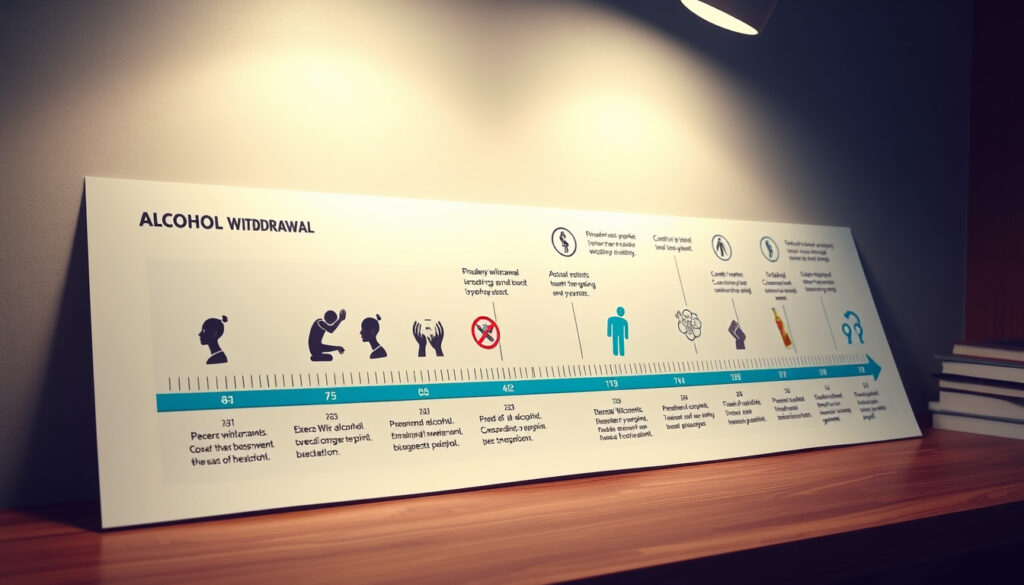
Alcohol Withdrawal Syndrome Symptoms: Timeline & Signs
Quitting heavy drinking carries a hidden clock: the body protests within hours, and for half of those with alcohol use disorder, that protest is a medical emergency. The worst symptoms concentrate in days 2-3—a window where seizures and delirium tremens can be fatal without medical supervision.
Common symptoms onset: 6-12 hours after last drink · Peak withdrawal risk: Days 2-3 · Severe cases incidence: 5% of withdrawals · Duration mild cases: 3-7 days · Heavy drinkers affected: 50% experience withdrawal
Quick snapshot
- Withdrawal symptoms begin 6-24 hours after stopping heavy use (Cleveland Clinic Health Encyclopedia)
- Hallucinosis appears 12-24 hours after last drink (American Academy of Family Physicians Clinical Guidelines)
- Seizures peak 24-48 hours after last drink (AAFP Clinical Guidelines)
- Average withdrawal lasts 4.83 days per survey of 2,136 adults (The Recovery Village Detox Survey)
- Exact liver recovery timeline varies by individual
- Which specific day carries the highest risk varies person to person
- Post-acute withdrawal symptoms (PAWS) durations are inconsistent across sources
- 6-12 hours: Anxiety and tremors begin
- 12-48 hours: Hallucinations possible
- 48-72 hours: Delirium tremens peak
- 5-7 days: Symptoms subside for most
- Mild cases resolve in 3-7 days with monitoring
- Medical detox may reduce severe symptom risk, according to clinical protocols
- Continued recovery spans weeks to months post-acute phase
| Timeline point | Symptoms |
|---|---|
| 6-12 hours after last drink | Anxiety, mild tremors, headache, nausea, insomnia |
| 12-24 hours | Alcoholic hallucinosis (auditory, visual, or tactile) |
| 24-48 hours | Seizure risk highest; possible confusion, elevated heart rate |
| 48-72 hours | Delirium tremens peak; fever, disorientation, hypertension |
| 5-7 days | Acute symptoms subside for most people |
| Weeks 2-4 | Protracted fatigue, mood changes possible |
What are 5 symptoms of withdrawal?
Alcohol withdrawal produces a wide spectrum of symptoms, ranging from barely noticeable to life-threatening. The American Academy of Family Physicians notes that withdrawal effects stem from unmasking the body’s adaptive responses to chronic alcohol exposure. Severity often follows a predictable pattern tied to how long and how heavily someone drank.
Mild symptoms
The first wave hits within hours and resembles a bad hangover amplified times three. Anxiety ranks among the most common early complaints, sometimes described as a sense of dread or jumpiness that has no obvious trigger. Headache, nausea without vomiting, and insomnia round out the mild picture. Tremors—visible shaking, usually in the hands—may appear but remain subtle enough that someone could still function with effort. These symptoms correspond to CIWA-Ar scores of 8 or less, meaning outpatient management is often viable.
Moderate symptoms
By the 12-48 hour window, the body escalates its response. Vomiting, confusion, elevated heart rate, and noticeable spikes in blood pressure signal that the nervous system is in full compensation mode. Hallucinations—typically visual (seeing things that aren’t there) or auditory—may emerge at this stage. The Priory Group reports that moderate symptoms develop during this window and often frighten people into seeking help, which is exactly when medical supervision becomes critical. CIWA-Ar scores in the 8-15 range indicate moderate withdrawal requiring closer monitoring.
Severe symptoms
For roughly 5% of those experiencing withdrawal, symptoms cross into medical emergency territory. Seizures—specifically generalized tonic-clonic episodes—typically occur 24-48 hours after the last drink. The AAFP clinical guidelines document this as one of the most dangerous early milestones. Beyond seizures, delirium tremens (DTs) represents the most severe manifestation, characterized by agitation, disorientation, fever, and hallucinations occurring 48-72 hours after cessation. Cleveland Clinic identifies that DTs carries a fatality rate of 5-10% even with treatment, making this a condition that demands professional medical management.
How long does alcohol withdrawal last?
The acute phase of alcohol withdrawal typically runs 5-7 days for most people, though individual variation is substantial. A survey of 2,136 adults conducted by The Recovery Village found an average duration of 4.83 days, suggesting that while a week is a reasonable expectation, many people clear symptoms faster. What complicates this picture is that symptoms don’t arrive all at once—they cascade in stages tied to specific time windows after the last drink.
Mild withdrawal duration
For those with mild-to-moderate symptoms (CIWA-Ar scores under 15), the peak and resolution often occur within 24-72 hours. Cleveland Clinic confirms that mild-to-moderate cases typically peak during this window and begin resolving thereafter. Someone experiencing only anxiety, tremors, and insomnia might feel substantially better within 48-72 hours of their last drink, assuming no underlying health complications.
Severe withdrawal timeline
When seizures or DTs enter the picture, the timeline extends considerably. DTs onset typically occurs 48-72 hours after cessation, peaks around days 3-4, and can persist for 3-8 days according to Nova Transformations data. In some documented cases, delirium tremens may emerge up to 7-10 days after the last drink, which is why medical professionals monitor high-risk patients well past the one-week mark. The American Society of Addiction Medicine guidelines emphasize that severe withdrawal requires inpatient treatment and benzodiazepines, with monitoring often continuing for days beyond symptom resolution.
Alcohol Withdrawal Timeline: What Symptoms to Expect in Days 1-5
The most useful way to understand alcohol withdrawal is to think of it as a day-by-day progression rather than a single event. Each time window brings predictable challenges, and knowing what’s coming can reduce panic when symptoms intensify. PMC research confirms that withdrawal follows a consistent neurological trajectory tied to how quickly the brain readjusts to functioning without alcohol.
Day 1 symptoms
Hours 6-12 bring the first wave of symptoms: anxiety, mild tremors, headache, and nausea. Some people report insomnia and a general sense of unease. For light-to-moderate drinkers, this may be the only noticeable phase. The AAFP confirms that symptoms like anorexia, gastrointestinal upset, headache, insomnia, mild anxiety, palpitations, and tremulousness commonly appear during this window. Blood pressure may rise slightly, but most vital signs remain within manageable ranges.
Day 2-3 peak
This is the danger zone. By hours 12-48, hallucinations may begin (typically visual), and seizure risk climbs steeply. The 48-72 hour mark represents the peak of delirium tremens risk. PMC research documents that seizures most commonly occur 6-48 hours after the last drink, while DTs onset happens 48-72 hours after cessation. Physical symptoms peak around 72 hours according to NCBI StatPearls, with fever, rapid heartbeat, elevated blood pressure, and drenching sweats characterizing the worst moments. This is when medical supervision shifts from recommended to essential.
Days 4-5 resolution
After 72 hours, the acute crisis typically passes. Symptoms generally lessen for most people, though fatigue, mood swings, and disrupted sleep may linger for weeks. The Recovery Village notes that most people complete detox within 7-10 days, with the early days (1-5) being the most medically intense. By day 5, someone who experienced only mild symptoms may feel nearly normal, while someone who had seizures or DTs is likely still under medical care but past the highest-risk window.
“The peak of withdrawal often occurs after about 48–72 hours after your last drink. This is the hardest part of withdrawal.”
— Recovery Atlanta (Treatment Center)
Days 2-3 account for most medical emergencies in alcohol withdrawal. Attempting detox without supervision during this window is genuinely dangerous.
What day is the hardest when quitting alcohol?
For the majority of people, day 2 or day 3 delivers the hardest physical experience. The body’s compensatory mechanisms have been stripped away by the absence of alcohol, and the nervous system is still recalibrating. Multiple sources converge on the 48-72 hour window as the period of peak intensity. Recovery Atlanta specifically identifies this window as “the hardest part of withdrawal,” a characterization that aligns with clinical observations across treatment centers.
Peak intensity day
The science points to 48-72 hours after the last drink as when physical symptoms reach their maximum severity. According to the AAFP clinical guidelines, delirium tremens typically peaks during days 3-4, which corresponds to the 72-hour mark. NCBI StatPearls research confirms that symptoms peak around 72 hours. For someone going through withdrawal without medication, this is when nausea becomes retching, anxiety becomes panic, and tremors may progress toward seizures.
Factors influencing severity
Not everyone peaks on the same day, and several factors determine individual trajectories. History of previous detox episodes matters—people who’ve gone through withdrawal before often have more severe subsequent episodes. Age plays a role, with older patients at higher risk for DTs. Concurrent medical conditions (especially liver disease) and concurrent use of other substances compound risk. UT Health notes that DTs usually occurs 2-4 days after cessation, and the exact timing depends on overall health status and drinking history. A person with decades of heavy drinking and multiple detox attempts will likely experience a harder, longer peak than someone who drank heavily but briefly.
“Delirium tremens has a fatality rate of 37% if untreated and is considered a medical emergency.”
— Recovery Atlanta (Treatment Center)
For those who develop DTs without medical intervention, the fatality risk climbs dramatically. Medical supervision during days 2-4 prevents deaths that would otherwise occur.
When you stop drinking alcohol, what are the side effects?
Stopping alcohol triggers a cascade of effects that extend well beyond the acute withdrawal window. The immediate side effects are what bring most people to medical attention—the tremors, nausea, and anxiety that make quitting feel impossible. But there are longer-term recovery effects worth understanding from the start, so the weeks after the first week don’t catch you off guard.
Immediate effects
The first hours and days bring sweating, insomnia, elevated heart rate, and fluctuating blood pressure. American Addiction Centers documents that visual, auditory, and tactile hallucinations may begin within 24 hours for some people. GI symptoms (nausea, reduced appetite) are common. Mood effects include anxiety, irritability, and sometimes low-grade depression. These symptoms are the body’s normal response to removing a sedating substance it has adapted to over time.
Longer-term recovery
Once the acute phase passes, many people report improved sleep (eventually), stabilized mood, and gradually normalizing energy levels over weeks 2-4. The liver begins recovering immediately upon alcohol cessation, though full regeneration depends on the extent of prior damage. Harvard Health notes that the body undergoes significant changes when stopping prolonged alcohol use, with benefits extending to cardiovascular health, liver function, and cognitive clarity over months. Post-acute withdrawal symptoms (PAWS)—including anxiety, insomnia, and fatigue—may wax and wane for weeks or months in some individuals, which is why ongoing support matters beyond the initial detox phase.
“Withdrawal effects are primarily due to the unmasking of the adaptive responses to chronic alcohol use.”
— AAFP (Medical Association)
Weeks 2-4 can feel deceptively easy—symptoms have faded, and motivation to continue sobriety may wane. This is when relapse risk peaks without ongoing support structures in place.
Alcohol Withdrawal Timeline: Days 1 Through Week 1+
The timeline below maps the progression from the first tremor to the point where most people feel they have turned a corner. Clinical sources including the AAFP, PMC, and Cleveland Clinic converge on these time windows with remarkable consistency, though individual experiences vary based on drinking history, health status, and whether medical intervention occurs.
| Time window | Event |
|---|---|
| 6-12 hours | Anxiety, tremors begin |
| 12-48 hours | Hallucinations, seizures possible |
| 48-72 hours | Delirium tremens peak |
| 5-7 days | Symptoms subside for most |
| Weeks 2-4 | Protracted fatigue, mood changes |
The pattern that emerges from clinical data is clear: withdrawal follows a predictable neurological arc. Symptoms start mild, peak around day 2-3, and gradually resolve for most people within a week. The variables are severity and duration. Someone with a decades-long drinking history, previous detox episodes, or concurrent health conditions will experience a more intense peak and longer timeline than someone with a shorter, lighter drinking history. Medical intervention—specifically benzodiazepines and supportive care—substantially reduces the risk of seizures and DTs, cutting fatality rates dramatically.
What’s confirmed
- Core symptoms are consistent across major medical sources
- Timeline stages follow a predictable neurological progression
- DTs fatality rate without treatment: 37%
What remains unclear
- Exact liver detox days vary individually
- Which specific day carries highest risk varies person to person
- PAWS duration data inconsistent across sources
For heavy drinkers deciding to quit, the message is unambiguous: days 2-3 carry the highest medical risk, and that window is precisely when professional supervision saves lives. Delirium tremens and seizures are not rare catastrophes—they occur in a measurable percentage of withdrawal cases, and their fatality rates are substantial. Medical detox programs exist for this reason, and the data on treatment success rates should give anyone considering quitting alone serious pause.
Related reading: High Grade Fever · Pain on Left Side of Stomach
novatransformations.com, edgewoodhealthnetwork.com, priorygroup.com, ncbi.nlm.nih.gov, med.uth.edu, americanaddictioncenters.org, asam.org, samhsa.gov
Early anxiety and tremors signal the start, but the full timeline stages and risks highlights escalating dangers like seizures and delirium tremens by days 2-3.
Frequently asked questions
How many alcohol-free days does it take to cleanse the liver?
The liver begins recovering immediately after alcohol cessation, but full regeneration depends on the extent of prior damage. Mild fatty liver changes can reverse within weeks of stopping drinking. More advanced damage (fibrosis or cirrhosis) is slower or may be permanent. Medical imaging and liver function tests at 2-4 weeks post-cessation give a clearer picture than any generic timeline.
What happens after 3 weeks of no alcohol?
By week 3, most people report improved sleep, more stable mood, and gradually increasing energy. Liver function tests typically show measurable improvement by this point. Post-acute withdrawal symptoms (anxiety, insomnia, fatigue) may still be present but generally diminish. Sleep architecture continues improving through month 2-3.
What are the first signs of liver damage from alcohol?
Early signs include elevated liver enzymes (AST/ALT ratio >2:1), fatigue, and mild abdominal discomfort—often detected through blood tests before symptoms appear. As damage progresses, jaundice (yellowing skin/eyes), swelling in the abdomen or legs, and confusion may develop. Anyone with a heavy drinking history should request liver function testing when quitting.
How long does it take your liver to detox from alcohol?
The liver metabolizes alcohol at a relatively fixed rate (approximately one standard drink per hour), but “detox” in the broader sense—recovery from alcohol-related damage—takes far longer. Acute alcohol clearing from the bloodstream takes hours. Liver enzyme normalization may take 2-4 weeks. Reversal of fatty liver can take 4-6 weeks to months. Advanced damage may be permanent.
When should someone experiencing alcohol withdrawal seek medical help?
Anyone with a history of heavy daily drinking (typically more than 10 drinks daily for men, 7 for women) should seek medical supervision before quitting. Seek emergency care immediately if seizures occur, if hallucinations persist beyond a few hours, or if confusion, fever, or rapid heartbeat develop after day 1. Err on the side of caution—DTs is easier to prevent than to survive.
Is medical detox necessary for everyone quitting alcohol?
No—people with mild drinking histories (few drinks per day, short duration) may withdraw safely at home. However, anyone with a history of withdrawal symptoms, heavy daily drinking, concurrent medical conditions, or polysubstance use should pursue medical detox. The CIWA-Ar assessment tool (scores >15 indicate severe withdrawal) helps clinicians determine the appropriate setting.
More related posts
 Cruz Azul vs Club América Lineups: Preview & Prediction
 Where Is Hiatal Hernia Pain Located on a Woman? Location & Symptoms
 Morning Glory San Diego: Menu, Reservations & Michelin Guide Info
 Figure Skating Milano Cortina 2026: Schedule, Participants, Tickets
 LA Clippers vs Dallas Mavericks Player Stats (Mar 21, 2026)
 Boston Celtics vs Lakers Match Player Stats: Box Scores
 Weeds (TV Series): Cancellation, Reboot & Streaming
 Carnival Cruise New Rules: Banned Items and Backlash Explained
