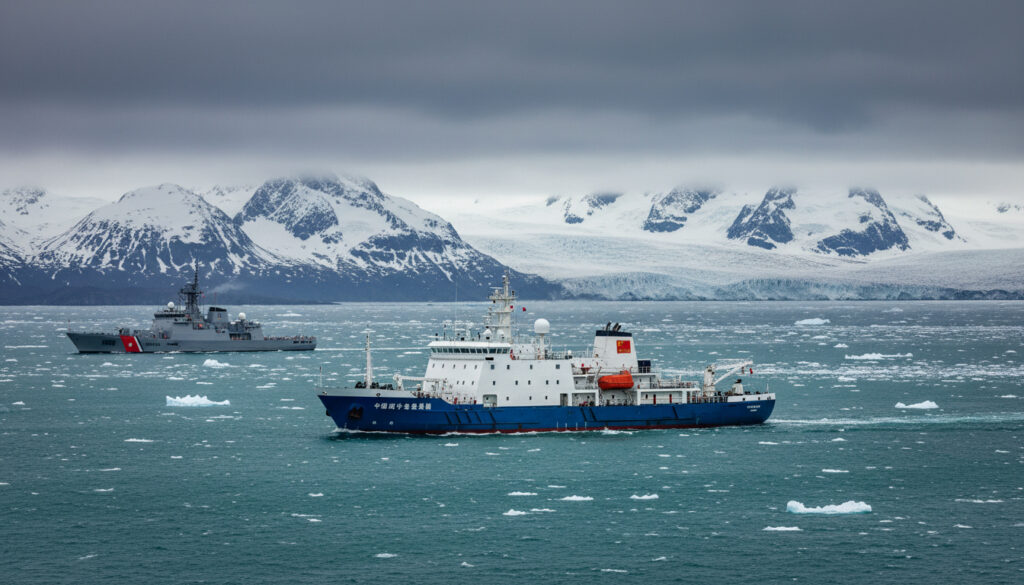
Chinese Research Vessel Detected Alaska – Timeline, Concerns, US Response
Chinese research vessels have drawn increased scrutiny from U.S. authorities following documented operations in Arctic waters near Alaska. While specific information regarding a vessel designated “Ke Xue San Hao” operating in July 2024 was not identified in official records, the U.S. Coast Guard has confirmed tracking five distinct Chinese-flagged research platforms conducting activities within the American Extended Continental Shelf during 2025.
The documented vessels include the icebreaker Xue Long 2, operated by China’s Polar Research Institute, alongside Shen Hai Yi Hao, Zhong Shan Da Xue Ji Di, Ji Di, and Tan Suo San Hao. These operations occurred 200 to 290 nautical miles off Utqiagvik, Alaska, amid heightened geopolitical tensions and unprecedented joint Russian-Chinese military air patrols in the region.
This examination details the confirmed detections, vessel capabilities, and strategic implications of sustained Chinese maritime research presence in American Arctic zones.
What Chinese research vessel was detected near Alaska?
Xue Long 2, Shen Hai Yi Hao, Zhong Shan Da Xue Ji Di, Ji Di, Tan Suo San Hao
August–September 2025
U.S. Extended Continental Shelf, 130–265 nautical miles offshore
U.S. Coast Guard 17th District
- Multiple Assets Deployed: Five separate Chinese research vessels operated simultaneously or sequentially, representing a coordinated research presence rather than isolated transits.
- Extended Continental Shelf Operations: Vessels conducted surveys 130 nautical miles inside the ECS boundary, where the U.S. claims exclusive resource management rights.
- Response Escalation: The Coast Guard bolstered surface presence specifically to monitor these operations, deploying cutters and maritime patrol aircraft.
- Strategic Timing: Vessel activities coincided with the first joint Russian-Chinese aircraft incursion into the Alaska Air Defense Identification Zone in July 2024.
- Proximity Variations: Positions ranged from 200 to 290 nautical miles north of Utqiagvik, indicating systematic survey patterns across the Chukchi Sea region.
| Fact | Details | Source |
|---|---|---|
| Vessel Identities | Xue Long 2, Shen Hai Yi Hao, Zhong Shan Da Xue Ji Di, Ji Di, Tan Suo San Hao | U.S. Coast Guard |
| Xue Long 2 Position | 290 nautical miles north of Utqiagvik, 130 nautical miles inside ECS boundary | U.S. Coast Guard |
| Operational Dates | August–September 2025 | Stars and Stripes |
| Geographic Scope | U.S. Extended Continental Shelf beyond 200-nautical-mile limit | CBS News |
| Primary Operator | Polar Research Institute of China (Xue Long 2) | U.S. Coast Guard |
| Concurrent Activity | Joint Russian-Chinese aircraft incursion into Alaska ADIZ (July 2024) | CBS News |
What is known about the vessel and its capabilities?
The documented vessels represent China’s modern oceanographic research fleet, equipped for deep-sea mapping, seabed sampling, and atmospheric data collection. The Xue Long 2 serves as a polar icebreaker capable of independent Arctic navigation, distinguishing it from earlier research platforms requiring icebreaker escorts.
Research capabilities and equipment
Chinese research vessels operating in Arctic waters typically carry multibeam sonar systems for bathymetric mapping, sub-bottom profilers for geological surveys, and equipment for water column sampling. These capabilities support dual-use applications including submarine navigation charting and undersea infrastructure assessment.
Operational patterns
Vessels maintained stationary or slow-speed positions 200–265 miles offshore, suggesting systematic survey patterns rather than transit operations. The Coast Guard noted coordinated movements requiring sustained surface presence to monitor effectively.
The Xue Long 2 is China’s first domestically built polar icebreaker, capable of breaking 1.5-meter ice at speeds of 3 knots, enabling independent year-round Arctic operations without requiring escort vessels.
Why is the presence of a Chinese research vessel near Alaska concerning?
Operations within the U.S. Extended Continental Shelf raise specific sovereignty and security questions. While international law permits research activities in international waters, the collection of high-resolution seabed data in zones where the U.S. claims exclusive resource rights creates strategic ambiguity regarding commercial and military applications.
Extended Continental Shelf implications
The ECS extends American jurisdiction beyond the standard 200-nautical-mile exclusive economic zone for purposes of seabed resource management. Chinese vessels operating 130 miles inside this boundary collect geological data relevant to potential resource claims and submarine warfare planning in an area where the U.S. asserts exclusive authority.
Dual-use research risks
Oceanographic data serves both civilian climate research and military submarine operations. High-resolution bathymetric maps facilitate submarine navigation in under-ice environments, while acoustic profiles inform underwater detection strategies. The timing of these operations alongside joint Russian-Chinese air patrols amplifies concerns regarding coordinated strategic intelligence gathering.
The United Nations Convention on the Law of the Sea permits marine scientific research in international waters, including portions of the ECS. However, coastal states maintain sovereign rights over seabed resources in these extended zones, creating legal friction regarding data ownership and resource claim validation.
What has been the US response?
The Coast Guard deployed cutters and maritime patrol aircraft to maintain visual and electronic monitoring of the Chinese vessels. Officials emphasized that while the operations occurred in international waters, the proximity to sensitive Arctic infrastructure and the scope of data collection necessitated persistent American presence.
Surface and air monitoring
Seventeenth District forces established regular communication protocols with the research vessels while maintaining tactical standoff distances. The Coast Guard’s continuous response involved rotating assets to ensure uninterrupted surveillance throughout August and September 2025.
Diplomatic and strategic communication
U.S. officials have publicly disclosed vessel tracking data through press releases, indicating a strategy of transparency regarding Chinese activities. Specific diplomatic protests or direct communications with Beijing regarding these particular operations have not been publicly detailed.
The Coast Guard has not released specific details regarding counter-intelligence measures employed during these encounters, citing operational security protocols for ongoing maritime domain awareness missions in the Arctic.
When did Chinese research vessel activity near Alaska occur?
-
First joint Russian-Chinese bomber incursion into Alaska Air Defense Identification Zone establishes precedent for coordinated Sino-Russian military activity near U.S. Arctic territories.
-
U.S. Coast Guard detects multiple Chinese research vessels operating 200–265 miles off Utqiagvik, Alaska. Response protocols activated with surface asset deployment.
-
Xue Long 2 identified 290 nautical miles north of Utqiagvik, operating 130 nautical miles inside the U.S. Extended Continental Shelf boundary.
-
Continued monitoring operations documented; Coast Guard maintains surface presence as vessels conduct extended hydrographic surveys.
What is confirmed and what remains uncertain?
Established Information
- Five Chinese research vessels operated in U.S. Arctic waters: Xue Long 2, Shen Hai Yi Hao, Zhong Shan Da Xue Ji Di, Ji Di, and Tan Suo San Hao
- Operations occurred August–September 2025 within the U.S. Extended Continental Shelf
- U.S. Coast Guard provided official confirmation, tracking, and public statements
- Vessels maintained positions 130–290 nautical miles from Utqiagvik
Information Remaining Unclear
- Specific operational records for a vessel named “Ke Xue San Hao” near Alaska in July 2024
- Exact mission objectives and specific data collection priorities for the documented vessels
- Current real-time locations of vessels following the September 2025 monitoring period
- Whether operations involved direct coordination with Russian maritime assets
How does this fit into broader Arctic security trends?
Arctic militarization has accelerated as diminishing ice coverage opens new shipping lanes and resource extraction opportunities. China’s 2018 Arctic Policy white paper declared the nation a “near-Arctic state,” justifying expanded research and economic activity despite geographic distance from the Arctic Circle.
The documented vessel activities align with Beijing’s “Polar Silk Road” initiative, which frames Arctic development within China’s broader Belt and Road infrastructure strategy. Concurrent Russian military expansion along the Northern Sea Route creates potential for coordinated Sino-Russian mapping and surveillance capabilities that could challenge American Arctic dominance.
For context on international maritime incidents portrayed in media, Watch My Fault (Film) – Prime Video Streaming Guide provides narrative exploration of geopolitical tensions, though fictionalized.
What have officials said about the incidents?
“The Coast Guard continues to respond to Chinese research vessel activity in the U.S. Arctic.”
— U.S. Coast Guard 17th District, Official Press Release
Official statements confirm vessels operated within the U.S. Extended Continental Shelf, requiring continuous surface presence to maintain maritime domain awareness.
— U.S. Coast Guard Public Affairs
What are the key takeaways?
Documented Chinese research vessel operations near Alaska involved five identifiable vessels conducting surveys within the U.S. Extended Continental Shelf during August and September 2025. While specific reports regarding a “Ke Xue San Hao” remain unverified in official channels, the confirmed presence of Xue Long 2 and other research platforms prompted sustained Coast Guard monitoring amid broader Arctic security concerns. Those seeking streaming content related to international maritime incidents may consult the Watch My Fault (Film) – Prime Video Streaming Guide.
Frequently asked questions
What specific activities were the Chinese vessels conducting?
Official reports indicate oceanographic research including bathymetric mapping and water column sampling, though specific mission parameters were not fully disclosed by Chinese operators or U.S. authorities.
Where are the vessels currently located?
Current real-time locations have not been publicly released following the conclusion of active Coast Guard monitoring operations in September 2025.
Is it legal for Chinese vessels to operate in these waters?
Operations in international waters, including portions of the Extended Continental Shelf, are legal under international law, though data collection in ECS zones raises questions regarding resource claim validation.
How does this compare to previous incidents?
The 2025 operations represent increased frequency and coordination compared to prior sporadic Chinese research missions in the Arctic, marking the first documented simultaneous operation of five vessels.
What is the Extended Continental Shelf?
The ECS extends beyond 200 nautical miles where coastal states have sovereign rights over seabed resources, distinct from exclusive economic zone surface waters rights.
More related posts
 Did LeBron James Retire? 2026 Status and Net Worth
 Saoirse-Monica Jackson: Age, Net Worth, Biography, and More
 Minnesota Vikings vs New York Giants: Player Stats (Dec 21)
 Purina Pro Plan Sensitive Skin and Stomach – In-Depth 2025 Review
 How Tall is Timothée Chalamet? 5’10” (178 cm) Facts
 How Many Mission Impossible Movies Are There
 FIFA World Cup 2022: Qatar Host, Argentina Winner, Full Recap
 Kidney Location in Body: Anatomy, Pain, and Early Signs
