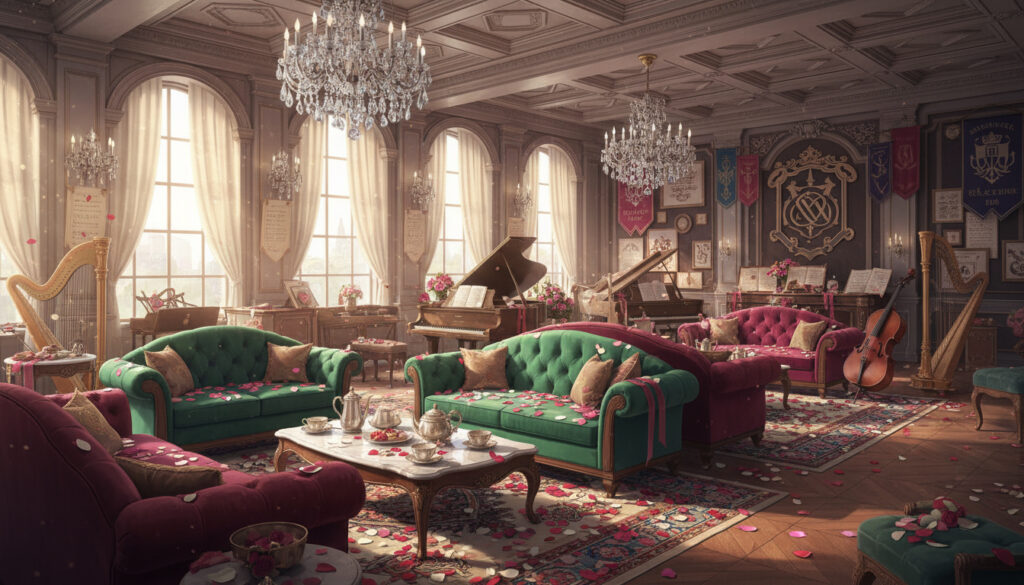
Ouran Highschool Host Club – Plot, Themes and Cultural Impact
Ouran High School Host Club is a Japanese romantic comedy manga series written and illustrated by Bisco Hatori. Serialized in Hakusensha’s LaLa magazine from September 2002 to November 2010, the series follows Haruhi Fujioka, a scholarship student at the elite Ouran Academy who stumbles into the school’s Host Club—a group of wealthy male students who entertain female clients—and must work off a debt by posing as a male host herself. The franchise spans 18 manga volumes, a 26-episode anime adaptation by Bones studio, and a 2012 live-action drama.
The narrative deconstructs class divides and gender roles within the insulated world of ultra-wealthy Tokyo high school culture. Through comedic escapades and themed hosting events, the series examines identity, found family, and romantic development among seven core members who initially bond over financial obligation rather than friendship.
Nearly two decades after its debut, the series maintains significant cultural cachet, experiencing periodic resurgences on social media platforms and remaining a definitive entry in the reverse harem genre. Its availability on major streaming services has introduced the property to successive generations of viewers.
What is Ouran High School Host Club About?
Key Insights
The series distinguishes itself within the reverse harem genre through sharp self-awareness and satirical edge. While most entries in the category focus primarily on romantic fantasy fulfillment, Ouran High School Host Club leverages its premise to critique the excesses of wealth and the artificiality of gender performance.
Haruhi’s characterization as an apathetic protagonist uninterested in wealth or romance provides a necessary foil to the eccentric personalities surrounding her. The dynamic creates comedy through contrast while allowing the narrative to explore genuine emotional growth across its ensemble cast.
The anime adaptation, directed by Takuya Igarashi, remains faithful to the manga’s tone while resolving plot threads in ways that differ from the original serialization. This divergence has generated ongoing discussion among fans regarding the comparative merits of each ending.
Series Overview
| Aspect | Details |
|---|---|
| Original Publisher | Hakusensha |
| English Publisher | Viz Media |
| Anime Director | Takuya Igarashi |
| Music | Yoshihisa Hirano |
| Licensed By | Funimation, Netflix (current) |
| Live Action Adaptation | 2012 TV Drama (11 episodes) |
Production Details
Bones produced the animated series during a period widely considered the studio’s golden age of adaptation. The animation quality utilizes a distinctive aesthetic characterized by soft color palettes and exaggerated character expressions that enhance the comedic timing without sacrificing emotional resonance.
The voice cast features notable performances including Maaya Sakamoto as Haruhi and Mamoru Miyano as Tamaki Suoh. The English dub, produced by Funimation, gained particular recognition for its localization choices, including the decision to have Caitlin Glass direct and voice Haruhi, creating performances that many viewers consider definitive.
Musical direction by Yoshihisa Hirano incorporates classical motifs that underscore the elite academy setting while contrasting with the series’ slapstick elements. The opening theme, “Sakura Kiss” by Chieko Kawabe, remains culturally synonymous with mid-2000s anime fandom.
Chronological Timeline
- : Manga serialization begins in LaLa magazine
- : Anime television series premieres on Nippon TV
- : Anime concludes with 26th episode
- : Manga serialization concludes after 18 volumes
- : North American localization begins through Viz Media
- : Live-action drama adaptation airs on TBS
- : Resurgence in streaming availability on Netflix and Crunchyroll
Clarifying Common Misconceptions
Despite initial appearances, Ouran High School Host Club does not constitute a boys’ love (BL) series. While the narrative playfully engages with tropes common to the genre through Tamaki’s flamboyant behavior and the club’s performative femininity, the romantic narrative focuses on heterosexual pairings, specifically the developing relationship between Haruhi and Tamaki.
The series also frequently prompts questions regarding its completion status. The manga ran to definitive completion in 2010, resolving all major character arcs and romantic subplots. The anime adaptation, while concluding with an original ending that diverges from the manga’s final volumes, provides narrative closure sufficient for standalone viewing.
Regarding accessibility, the series currently streams in high definition across multiple platforms, though availability varies by region. The English dub remains the preferred viewing method for many international fans due to its naturalistic adaptation of Japanese honorifics and cultural references.
Thematic Analysis
Ouran High School Host Club operates as a sustained examination of economic stratification masked behind confectionary aesthetics. The physical space of the host club—an extravagant music room three times larger than standard classrooms—serves as a microcosm of wealth accumulation, with the characters’ interactions constantly mediated by financial awareness.
The narrative’s treatment of gender proves equally sophisticated. Haruhi’scross-dressing is initially pragmatic—she possesses no uniform and no means to purchase one—yet evolves into a vehicle for examining essentialist assumptions about masculinity and femininity. Her indifference toward gender performance disrupts the binary systems maintained by both the academy and the club itself.
The found family trope manifests through the club’s gradual shift from business arrangement to genuine kinship. Each member enters the group seeking transactional benefit—debt relief, entertainment, access—yet remains through developing emotional bonds that transcend class boundaries.
Defining Moments
“You don’t have to put on a fake smile for me. If you’re going to smile, smile because you’re happy, not because you have to.”
— Haruhi Fujioka, Episode 8
“I realized that even in a world full of false things, my feelings for you are real.”
— Tamaki Suoh, Episode 24
“We’re not just a club anymore. We’re family.”
— Kyoya Ootori, Episode 26
Summary
Ouran High School Host Club endures as a high-water mark for shojo adaptation through its sophisticated balancing of satire and sincerity. The series manages to critique the wealth excesses of its setting while maintaining affection for its flawed, privileged characters—a tonal tightrope that few comparable series have successfully walked.
For contemporary viewers discovering the series through streaming platforms, the animation style and cultural references may initially appear dated, yet the core thematic concerns regarding identity, class consciousness, and authentic connection remain strikingly relevant. The manga’s completed status provides definitive closure for invested readers, while the anime offers a self-contained narrative satisfactory for casual viewing.
The property’s resistance to cynical rebooting or unnecessary sequelization has preserved its reputation among anime discourse communities. Rather than attempting to recapture mid-2000s shojo aesthetics, new viewers encounter the series as a complete artifact—one that influenced subsequent reverse harem narratives while remaining singular in its execution.
Frequently Asked Questions
Where can I watch Ouran High School Host Club?
The anime series is available for streaming on Netflix and Crunchyroll in most regions. The English dub produced by Funimation is included alongside the original Japanese audio with subtitles.
Is the manga different from the anime?
Yes. The anime adapts approximately the first eight volumes of the manga, concluding with an original ending in 2006. The manga continued serialization until 2010, developing additional plotlines and character relationships not present in the animated series.
Does Haruhi end up with Tamaki?
In both the manga and anime, the central romance resolves with Haruhi and Tamaki acknowledging their mutual feelings. The manga provides more extensive epilogue material regarding their adult relationship.
What makes this a reverse harem?
The series qualifies as a reverse harem through its structure: one female protagonist surrounded by multiple male characters who develop romantic or protective feelings toward her. However, the narrative frequently satirizes the conventions of the genre even while employing them.
Is the live-action drama worth watching?
The 2012 Japanese television drama condenses the narrative into eleven episodes with significant tonal differences from the anime. It emphasizes physical comedy and slice-of-life elements while reducing the romantic development present in animated and printed versions.
More related posts
 Law of Conservation of Mass: Definition, History & Examples
 What Does Melanoma Look Like – Visual Guide to Early Detection
 Star Wars: The Rise of Skywalker – Box Office & Reception
 Big Mac Sauce Recipe: Ingredients and How to Make It
 Carnival Cruise New Rules: Banned Items and Backlash Explained
 Great British Baking Show: Prue Exit, 2026 Season News
 Thank You in Korean: Formal & Informal Phrases Guide
 What Does IMO Mean? Texting, Shipping & App Explained
