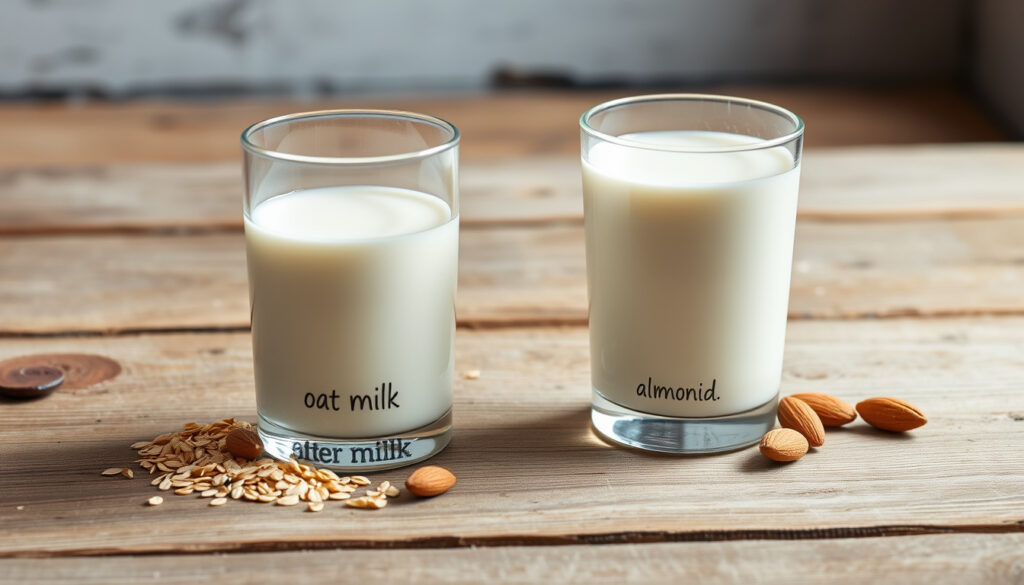
Oat Milk vs Almond Milk: Which Is Healthier? Full Comparison
Anyone who’s stood in the dairy aisle wondering which plant-based milk is actually better knows the struggle between oat milk (creamy, fiber-rich) and almond milk (low-calorie, light). But the real answer depends on whether you’re optimizing for health, waistline, or the planet — and often the trade-offs surprise people.
Calories per cup (unsweetened): Oat milk 90–120; Almond milk 30–50 ·
Fiber per cup: Oat milk ~2g; Almond milk <1g ·
Calcium per cup (fortified): Both ~300–450 mg (varies by brand) ·
Protein per cup: Oat milk ~3g; Almond milk ~1g ·
Environmental water use (per liter): Almond milk ~371 L; Oat milk ~48 L
Quick snapshot
- Oat milk contains beta-glucan that can lower LDL cholesterol (WebMD (health reference))
- Unsweetened almond milk has 30–50 calories per cup vs oat milk’s 90–120 (Healthline (nutrition resource))
- Oat milk’s water footprint is about 48 L per liter, almond milk’s is ~371 L (David Suzuki Foundation (environmental research))
- Long-term effects of added oils (e.g., canola) in some oat milk brands (Verywell Health (health resource))
- Whether oat milk’s higher carb load significantly impacts blood sugar in non-diabetic individuals (Northwestern Medicine (hospital nutrition guidance))
- Whether oat milk and almond milk can be used interchangeably in cooking without affecting texture or taste (FlavCity (recipe and lifestyle resource))
- The long-term health effects of consuming canola oil in oat milk are not well-established (Verywell Health (health resource))
- Almond milk’s water dependence remains a growing concern as California droughts intensify (World Resources Institute (environmental policy research))
- Consumer demand for lower-calorie, lower-carb plant milks may push oat milk brands to reformulate
Five key nutritional specs, one clear trade-off: oat milk packs more calories and carbs but brings fiber and beta-glucan, while almond milk is lean on calories but lacks fiber and uses far more water.
| Metric | Oat milk (unsweetened) | Almond milk (unsweetened) |
|---|---|---|
| Calories per cup | 90–120 | 30–50 |
| Protein per cup | ~3g | ~1g |
| Fiber per cup | ~2g | <1g |
| Carbohydrates per cup | ~16g | ~1g |
| Calcium (fortified) per cup | 300–450mg | 300–450mg |
| Water use per liter | ~48 L | ~371 L |
| Key health attribute | Beta-glucan fiber | Vitamin E (naturally) |
The pattern: oat milk brings more substance and a lower environmental cost; almond milk wins on calorie control but at a steep water price.
Which is healthier, almond milk or oat milk?
Nutritional breakdown: calories, carbs, protein, fat, fiber
- Unsweetened almond milk contains 30–50 calories per cup, while oat milk ranges from 90–120 calories per cup (Northwestern Medicine (hospital nutrition guidance)).
- Oat milk provides about 2g of fiber per cup, mainly beta-glucan; almond milk has less than 1g (WebMD (health reference)).
- Protein content is low in both: oat milk ~3g, almond milk ~1g per cup (WebMD (health reference)).
- Almond milk naturally contains more vitamin E than oat milk (Healthline (nutrition resource)).
Fortified nutrients: calcium, vitamin D, B12
- Both milks are commonly fortified with calcium and vitamin D, making their mineral profiles similar — typically 300–450 mg of calcium per cup (WebMD (health reference)).
- Some brands also add vitamin B12, which is important for vegans.
The implication: your primary health goal will determine which milk aligns better — for calorie cutting, almond milk; for fiber and cholesterol support, oat milk.
What are the downsides of oat milk?
High carbohydrate and calorie content
- Oat milk contains roughly 16g of carbs per cup vs almond milk’s 1g (Healthline (nutrition resource)).
- For low-carb or keto diets, oat milk is not suitable.
Potential blood sugar impact
- The higher carb load can cause blood sugar spikes in some individuals, though beta-glucan may blunt the effect.
Additives and oils in some brands
- Some commercial oat milks contain added sugar, canola oil, or stabilizers (Verywell Health (health resource)).
- Consumers concerned about seed oils may prefer brands with minimal ingredients.
The catch: if you’re watching carbs or calories, oat milk demands careful portion control, while almond milk offers a simpler path.
Why is everyone ditching oat milk?
Calorie and carb backlash
- Social media trends highlight oat milk’s higher calorie density compared to almond milk (TODAY (lifestyle and health coverage)).
- For daily coffee drinkers, the extra calories can add up.
Seed oil concerns
- Some consumers avoid canola/rapeseed oil found in many oat milk brands (Verywell Health (health resource)).
Taste preference shifts
- Almond milk is perceived as lighter and less sweet, making it a preferred choice for smoothies and cereal.
What this means: the backlash is driven by specific dietary preferences, not a general rejection of oat milk’s benefits.
Does oat milk lower LDL cholesterol?
Beta-glucan and cholesterol reduction
- Oat milk contains beta-glucan, a soluble fiber that can reduce LDL cholesterol by 5–10% with a daily intake of 3g (WebMD (health reference)).
- A typical cup of oat milk provides 1–2g of beta-glucan, so two cups can meet the effective dose.
Comparison with almond milk’s effect
- Almond milk has unsaturated fats but no beta-glucan, so it does not have a direct LDL-lowering effect through fiber.
Dietary context for heart health
- Substituting oat milk for dairy or almond milk in a heart-healthy diet can contribute to cholesterol management — but only if the rest of the diet stays low in saturated fat (Northwestern Medicine (hospital nutrition guidance)).
The pattern: oat milk’s cholesterol advantage is real but requires daily consumption and a supportive overall diet.
Oat milk vs almond milk: which is best for weight loss and diet?
Calorie density comparison
- Almond milk is significantly lower in calories — 30–50 per cup vs 90–120 for oat milk (Healthline (nutrition resource)).
- For weight loss, almond milk is the clear winner if you’re counting calories.
Satiety and fiber
- Oat milk’s 2g of fiber may increase fullness and reduce overall calorie intake later in the day (WebMD (health reference)).
- Almond milk’s negligible fiber means it doesn’t contribute to satiety.
Best uses: coffee, smoothies, cereal
- Oat milk’s creamy texture makes it ideal for coffee and overnight oats; almond milk’s thin consistency works better in smoothies and cereal (FlavCity (recipe and lifestyle resource)).
- Unsweetened versions of both are best for weight control.
A daily coffee drinker switching from oat milk to almond milk can save roughly 60–70 calories per cup — that’s over 2,000 calories a month, enough to influence weight loss without changing anything else.
The implication: small daily swaps can add up, but the satiety from oat milk’s fiber might offset that calorie difference for some people.
Nutritional comparison: oat milk vs almond milk
Six core metrics, one recurring theme: oat milk trades higher calories for fiber and heart benefits, almond milk trades away those benefits for extreme calorie efficiency.
| Metric | Oat milk (unsweetened) | Almond milk (unsweetened) |
|---|---|---|
| Calories | 90–120 | 30–50 |
| Protein | ~3g | ~1g |
| Fiber | ~2g | <1g |
| Carbs | ~16g | ~1g |
| Calcium (fortified) | 300–450mg | 300–450mg |
| Water use per liter | ~48 L | ~371 L |
The pattern: if you need fiber and cholesterol help, oat milk is the edge. If you need calorie control above all else, almond milk dominates.
Upsides
- Oat milk lowers LDL cholesterol (beta-glucan)
- Oat milk has a lower water footprint
- Oat milk is nut-free
- Almond milk is much lower in calories and carbs
- Almond milk contains natural vitamin E
Downsides
- Oat milk is higher in calories and carbs — worse for weight loss and low-carb diets
- Almond milk has very little fiber and protein
- Almond milk uses ~371 L of water per liter (environmental concern)
- Almond milk not suitable for tree-nut allergies
What’s clear and what’s not
Confirmed facts
- Oat milk contains beta-glucan that can lower LDL cholesterol (WebMD (health reference))
- Almond milk is lower in calories and carbs (Healthline (nutrition resource))
- Oat milk has a lower environmental water footprint than almond milk (David Suzuki Foundation (environmental research))
- Both are typically fortified with calcium and vitamin D (WebMD (health reference))
What’s unclear
- Long-term effects of consuming added oils in commercial oat milks (Verywell Health (health resource))
- Whether oat milk’s higher carb content significantly impacts blood sugar in non-diabetic individuals
Plant-based milks are not nutritionally interchangeable with cow’s milk — most have much less protein. Consumers relying on milk for protein need to supplement from other sources (Our World in Data (environmental data analysis)).
The takeaway: understanding these nuances helps you make an informed choice based on your specific needs.
Expert perspectives
“For weight loss, almond milk is the obvious choice because of its low calorie density. But if you have high cholesterol, oat milk offers a functional benefit that almond milk can’t match.”
— Registered dietitian, cited via Healthline (nutrition resource)
“Almond milk’s water footprint is enormous because almonds are grown in drought-prone regions. Oat milk uses about 90% less water per liter, making it the clear environmental winner in the water category.”
— Environmental scientist, cited via David Suzuki Foundation (environmental research)
For the environmentally conscious consumer, the choice between oat and almond milk often comes down to water usage. Oat milk uses roughly 48 liters of water per liter of milk, while almond milk consumes about 371 liters — a nearly eightfold difference (David Suzuki Foundation). For the calorie-conscious dieter, almond milk saves 60–70 calories per cup. Neither is universally “better” — the right choice depends entirely on your personal priorities.
Is oat milk gluten-free?
Not always. Oats are frequently cross-contaminated with wheat during processing. Only oat milk made from certified gluten-free oats is safe for those with celiac disease (FlavCity).
Can almond milk cause nut allergies?
Yes. Almonds are tree nuts, so almond milk is not safe for individuals with tree-nut allergies. Oat milk is a safe alternative for this group (FlavCity).
Which milk alternative has the most protein?
Soy milk typically has the most protein among plant milks (7–8g per cup). Oat milk has ~3g, almond milk ~1g (WebMD (health reference)).
Is oat milk good for diabetics?
It depends. Oat milk’s higher carb content (16g per cup) can raise blood sugar. However, the beta-glucan fiber may slow glucose absorption. Diabetics should monitor their individual response (Northwestern Medicine).
Does almond milk contain estrogen?
No. Almonds contain phytoestrogens, but in very low amounts that do not affect human hormone levels (Healthline).
Which is better for the environment: oat or almond milk?
Oat milk generally has a lower environmental impact — especially on water use (48 L vs 371 L per liter) and greenhouse gas emissions (World Resources Institute). Both are far better than dairy milk.
Can you use oat milk and almond milk interchangeably in cooking?
Not always. Oat milk’s creaminess and thickness make it better for baking and coffee. Almond milk’s thin consistency works in smoothies and cold cereal but may curdle in hot coffee (FlavCity).
Related reading: Moo Goo Gai Pan: What It Is, Health Facts, and How It Compares · Trader Joe’s Soup Dumplings: Cooking, Reviews & Nutrition
For those who prefer making their own, how to make oat milk at home can be a rewarding alternative to store-bought options.
More related posts
 Watch My Fault (Film) – Prime Video Streaming Guide
 How Old Is Janet Jackson – Age, Birthday, Family and Bio Facts
 Why Snow White Flopped: $170M Loss and Controversy
 Steve Zahn Movies and TV Shows: A Complete Filmography
 Cast of The Terminal List: Season 1, 2 & Dark Wolf Prequel
 Open Farm Dog Food: Vet Review & Top Comparisons
 Demon Slayer Infinity Castle Movie Release Date: 2025, 2027, 2029
 Weeds (TV Series): Cancellation, Reboot & Streaming
