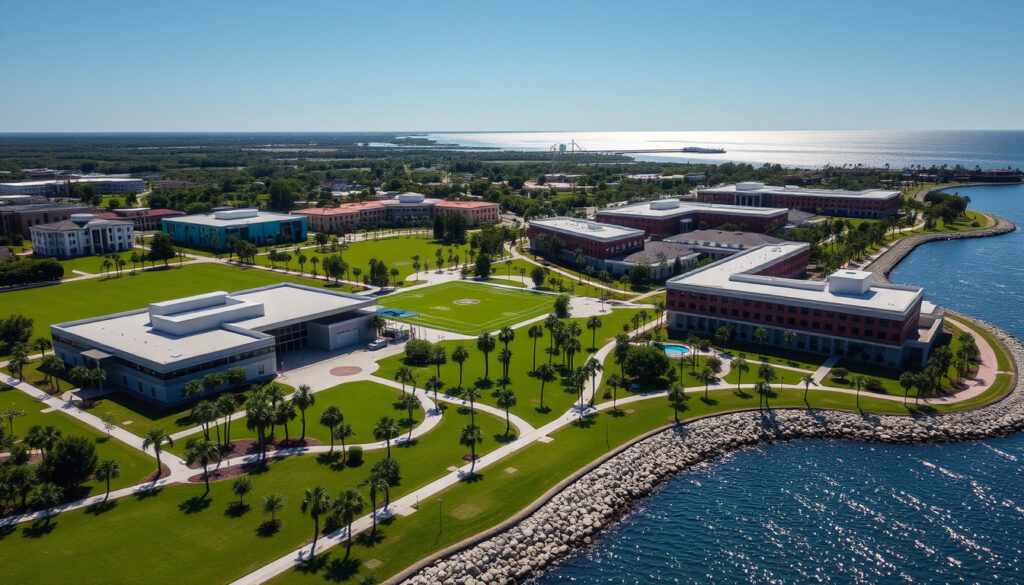
University of West Florida: Rankings, Tuition, Admissions & Athletics
Florida residents at the University of West Florida pay roughly 45% less than the national average in tuition and fees—and they do it while the university competes in NCAA Division II with 11 national championships across its 15 athletic programs. The university’s regional rankings have climbed steadily, making UWF a value story with growing academic credibility in Florida’s Panhandle.
Founded 1963 • Enrollment ~14,000 • US News #14 Regional Universities South • 11 National Championships • 4 Campuses: Pensacola main, Emerald Coast, Historic Trust, downtown
Admissions
- Acceptance rate 58% (Peterson’s)
- Average GPA 3.64, SAT range 1020–1230, ACT 20–27 (Niche)
- Fall application deadline April 1; notification November 30 (Peterson’s)
Costs
- FL resident $214/credit ($6,420/30 credits); AL $319/credit ($9,570); non-FL $708/credit ($21,240) (UWF Official)
- Net price $10,092/year; 91% receive aid averaging $9,595 (Niche)
- Argo 30 Guarantee: Pell-eligible FL residents pay no out-of-pocket tuition (UWF Official)
Academics
Athletics
- NCAA Division II, Gulf South Conference, 15 programs, 11 national championships (Niche)
- Football added 2023; men’s track scholarships available (NCSA Sports)
- Student reviews cite strong facilities and growing excitement for football (Niche)
The table below summarizes key facts for quick reference before diving into detailed sections.
| Category | Fact | Source |
|---|---|---|
| Type | Public university | Peterson’s |
| Location | Pensacola, FL 32514 | Peterson’s |
| Founded | 1963 | Princeton Review |
| Undergrad enrollment | 9,971 (6,885 full-time, 3,085 part-time) | Niche |
| US News rank | #14 Regional Universities South | College Simply |
| Athletics | 15 programs, 11 national championships, NCAA Division II | Niche |
| Average aid package | $11,035 | Peterson’s |
| Acceptance rate | 58% | Peterson’s |
| Average ACT | 25 | Peterson’s |
| Application fee | $30 | Peterson’s |
Is the University of West Florida a good university?
Rankings and reputation
UWF holds the #14 spot among Regional Universities in the South according to US News, placing it among the top public universities in Florida. Niche awards UWF a B+ overall grade, with specific strengths in Information Technology (#54 nationally), Nursing (#64 nationally), and College Athletics (#69 nationally) (Niche). College Simply data places UWF at #23 among all Florida colleges and #8 among public institutions in the state, while College Raptor ranks it #120 out of 402 universities in the Southeast region and #1 among the 16 Gulf South Conference schools for total enrollment (College Raptor).
Student outcomes
The graduation rate stands at 59%, with median debt after graduation at $13,000 according to 2aDays data. The net price of $10,092 per year sits well below the national average of $17,821, making outcomes relatively strong for the cost. The Princeton Review describes UWF as an “affordable mid-sized school” with “state-of-the-art engineering” and a “unique marine biology undergrad” program that distinguishes it from peer institutions.
Campus life
Located in Pensacola’s Ferry Pass area (classified as rural), UWF hosts roughly 9,971 undergrads with 28% of students over the age of 25—a sign of significant part-time and transfer student presence. Student reviews on Niche highlight strong athletics facilities and growing excitement around the addition of the football team.
Is UWF a hard school to get into?
Acceptance rate data
UWF accepts 58% of applicants, with 10,201 total applicants, 5,939 admitted, and 9,971 enrolling—numbers from Peterson’s that indicate a moderately selective profile. Female applicants show the same 58% acceptance rate (6,165 applied, 3,591 accepted). For context, the national average acceptance rate across all universities sits around 47%, making UWF more accessible than many institutions.
GPA and test score ranges
The average high school GPA for incoming freshmen is 3.64. SAT Critical Reading averages 580 (range 510–610), Math averages 565 (range 480–580), producing a combined range of 1020–1230 per Niche data. The ACT Composite averages 25 with a range of 20–27.
Admissions process
UWF charges a $30 application fee. The fall freshmen application deadline closes April 1, with notification sent by November 30—no rolling admissions. Contact the Admissions Director Katie Condon at admissions@uwf.edu or 850-474-2230 for questions.
“In-state Argos pay about 45% less annually than the national average in tuition and fees.”
— UWF Admissions, official university statement
How much does UWF cost each year?
Tuition and fees breakdown
UWF maintains a regional tuition structure with distinct pricing for Florida residents, Alabama residents, and non-Florida students. For the 2026–2027 academic year, Florida residents pay $214 per credit hour ($6,420 for a standard 30-credit load), Alabama residents receive a special rate of $319 per credit hour ($9,570), and non-Florida residents pay $708 per credit hour ($21,240) according to the official UWF tuition page.
Room and board
Estimated direct costs for 2026–2027 run $18,178 for Florida residents, $21,328 for Alabama residents, and $32,998 for non-Florida residents. These figures include housing ($6,622) and meals ($5,136) based on UWF’s official estimates.
Financial aid availability
UWF has not increased tuition in over a decade as of 2026, per the official admissions page. The average financial aid package totals $11,035, with 91% of students receiving aid averaging $9,595. Pell Grant recipients make up 35% of the student body. The Argo 30 Guarantee specifically covers Pell-eligible Florida residents, eliminating out-of-pocket tuition for fall and spring semesters for qualifying students.
“UWF has not increased tuition in a decade, and our special Alabama rate beats many in-state rates.”
— UWF Admissions, official university statement
What major is the University of West Florida known for?
Popular programs
UWF’s strongest niche rankings appear in Information Technology (#54 nationally) and Nursing (#64 nationally), per Niche data. The Princeton Review specifically highlights “state-of-the-art engineering” and a “unique marine biology undergrad” as distinguishing programs.
Degree details
Class sizes trend toward 20–29 students in typical lectures, creating a mid-sized feel that balances resources with accessibility. Peterson’s data shows an average freshman aid package of $10,774, indicating institutional investment in student success.
Unique offerings
Students on Niche review mention strong existing athletics programs alongside growing excitement for the football addition. The 35% Pell Grant recipient rate indicates a diverse student body with significant first-generation representation.
Is UWF a prestigious school?
National and regional rankings
UWF ranks #23 among all colleges in Florida and #8 among public institutions in the state per College Simply. Niche awards specific top-100 marks in Information Technology (#54), Nursing (#64), and College Athletics (#69). College Raptor positions UWF at #120 out of 402 Southeast-region institutions and #1 among Gulf South Conference schools by enrollment.
Athletics prestige
The university’s 11 national championships across its athletic programs shape its identity significantly. UWF competes in NCAA Division II with football (added 2023), soccer, basketball, baseball, softball, and track among its 15 programs. Student reviews note strong facilities and excitement around the football program’s growth. Varsity athletes are counted among the student body, per Niche.
Alumni success
The 59% graduation rate and $13,000 median debt suggest manageable outcomes for those who complete degrees. The $10,092 net price positions UWF as accessible relative to peer institutions.
“Athletics at UWF are developing, with students noting strong existing programs and facilities and excitement about the addition of a football team.”
— Niche Student Reviews
Pros
- Affordable tuition with Argo 30 Guarantee for qualifying FL residents
- Strong regional rankings and 11 national championships
- Active campus life with growing athletics programs
- Net price well below national average
Cons
- Moderate selectivity (58% acceptance rate)
- Out-of-state costs significantly higher
- Pensacola location can feel isolated for some students
- National brand recognition limited outside Florida
Related reading: Knicks vs Orlando Magic Timeline · New York Yankees vs Red Sox Matches
Frequently Asked Questions
What division is University of West Florida in?
UWF competes in NCAA Division II as a member of the Gulf South Conference. The university added football in 2023 and fields 15 athletic programs total.
Does University of West Florida have a football team?
Yes. UWF’s football program launched in 2023 as part of its NCAA Division II membership in the Gulf South Conference. Student reviews indicate strong excitement around the program’s development.
How many students go to University of West Florida?
UWF enrolls approximately 9,971 undergraduate students, with 6,885 attending full-time and 3,085 part-time. About 28% of students are over age 25.
What sports does UWF offer?
UWF offers 15 athletic programs including football, soccer, basketball, baseball, softball, and track. The department has won 11 national championships across various sports.
Where is the University of West Florida campus?
The main campus sits at 11000 University Parkway in Pensacola, FL 32514. UWF operates four campus locations: the main Pensacola campus, Emerald Coast, Historic Trust, and downtown sites.
What are UWF’s most popular majors?
Based on national rankings, UWF’s strongest programs include Information Technology (ranked #54 nationally), Nursing (#64 nationally), and Marine Biology (noted as unique by Princeton Review).
Does UWF offer online degrees?
Research notes indicate UWF serves diverse students including part-time and transfer populations, but specific online program details require verification from the official registrar or academic catalog.
What is UWF known for in athletics?
UWF has won 11 national championships across its athletic programs. The addition of football in 2023 generated significant student excitement, and existing programs like basketball and soccer maintain strong regional performance.
Prospective students should weigh the moderate 58% acceptance rate against their academic profile and compare UWF’s net price against alternatives in their intended major. The Argo 30 Guarantee makes UWF tuition-free for qualifying Florida Pell recipients—a significant advantage worth investigating early.
Admissions questions reach the office at admissions@uwf.edu or 850-474-2230, with an Admissions Director Katie Condon available for inquiries. The April 1 fall deadline and November 30 notification timeline make early planning essential.
More related posts
 Poker Face (TV Series): Season 3, Cast, Reviews
 How Are the Votes Going in La Casa de los Famosos Today?
 Phillies vs Tampa Bay Rays Match Player Stats (Mar 3, 2026)
 Couples Therapy Near Me: Cost, Methods & Ireland Guide
 Air Fryer French Fries: Perfect Crispy Recipe Guide
 Brandon Sklenar Movies and TV Shows: Complete Filmography (2025)
 Wheel of Fortune Tarot – Upright and Reversed Meanings
 The Life of a Showgirl: Controver y, Critic & Earning
