What Is a Bunion? Causes, Treatment, and Prevention
There’s a good chance you or someone you know has a bunion — that bony bump on the side of the big toe that makes wearing certain shoes a pain. More than just a cosmetic nuisance, a bunion is a progressive structural deformity that affects about 1 in 3 adults, according to the Cleveland Clinic (a leading academic medical center).
Adults with bunions: 1 in 3 ·
Gender ratio: Up to 10 times more common in women ·
Typical onset age: 30–50 years
Quick snapshot
- Genetic predisposition is a major risk factor (Cleveland Clinic) (NHS Lanarkshire (Scottish national health service))
- Tight, narrow footwear accelerates bunion formation (NHS Lanarkshire (Scottish national health service))
- Women are significantly more affected than men (Cleveland Clinic) (NHS Lanarkshire (Scottish national health service))
- Surgery is the only definitive way to remove the bony bump (NHS Lanarkshire) (NHS Lanarkshire (Scottish national health service))
- Why some individuals with identical risk factors never develop bunions (Mass General Brigham (a Harvard-affiliated health system))
- Exact rate of progression for each stage (PMC review of hallux valgus management)
- Long-term efficacy of different bunion corrector brands — limited comparative data (Mass General Brigham (a Harvard-affiliated health system))
- Bunions typically develop between ages 30 and 50 (Cleveland Clinic)
- Progression is gradual but can worsen without intervention (NHS Lanarkshire)
- Non-surgical treatments can manage symptoms and slow progression (PMC review) (AAOS (American Academy of Orthopaedic Surgeons))
- Surgery is an option for persistent pain — 80–90% patient satisfaction (AAOS (American Academy of Orthopaedic Surgeons))
Six key facts at a glance, one pattern: bunions are a joint deformity with a clear cause-and-effect chain, but outcomes vary widely depending on stage and treatment choice.
| Label | Value |
|---|---|
| Medical term | Hallux valgus |
| Common age of onset | 30–50 years |
| Prevalence | Affects about 1 in 3 adults |
| Gender disparity | Up to 10× more common in women |
| Primary non-surgical interventions | Proper footwear, bunion pads, orthotics, ice |
| Surgery success rate | 80–90% patient satisfaction (reliable sources) |
What causes you to get a bunion?
Does wearing narrow shoes cause bunions?
Yes, but it’s a combination of factors. Tight, narrow, or high-heeled shoes increase pressure on the big toe joint, which can accelerate the misalignment of the metatarsophalangeal joint. NHS Lanarkshire notes that tight shoes cause rubbing and friction over the bunion, leading to redness, swelling, and thickened skin. However, shoes alone rarely cause a bunion from scratch — they typically worsen an existing predisposition.
Are bunions hereditary?
Yes, family history is a strong contributor. Cleveland Clinic lists abnormal bone structure, increased motion, and shoe choice as recognized contributors. The NHS Lanarkshire guidance also mentions neuromuscular conditions, prior trauma, hypermobility, and age as risk factors.
What triggers a bunion?
The trigger is often a combination of biomechanical stress and inflammation. Mass General Brigham explains that hallux valgus can be painful even when the deformity appears mild, while some severe deformities cause minimal symptoms. Inflammatory arthritic conditions such as rheumatoid arthritis and psoriatic arthritis are also associated with bunion formation, per NHS Lanarkshire.
Genetics load the gun, but footwear pulls the trigger. For most people, the single most modifiable factor is the shape of the shoes they wear every day.
The implication: Bunions are not a single-cause condition. Heredity sets the stage, but lifestyle choices — especially footwear — determine how quickly the deformity progresses. For anyone with a family history, early shoe modifications are the most effective preventive step.
Key takeaway: Genetics and footwear combine to cause bunions. For those with a family history, choosing wide shoes early is the most effective way to slow progression.
How do you get bunions to go away?
What helps a bunion go away?
The only way to permanently remove the bony bump is surgery. NHS Lanarkshire states clearly: “Surgery is the only way to get rid of them, but there are things you can do to ease any pain.” Non-surgical treatments — bunion pads, orthotics, ice, and NSAIDs — can relieve pain and slow progression, but they do not reverse the structural deformity.
Can bunions shrink naturally?
No. Because the bump is a bony protrusion (the head of the first metatarsal bone that has shifted outward), it cannot shrink on its own. A PMC review article describes bunions as a prominent and inflamed metatarsal head with an overlying bursa — a structural bone deformity, not a fluid collection.
What are the best non-surgical treatments?
- Wide, roomy shoes with a low heel (Cleveland Clinic)
- Bunion pads and toe spacers to reduce friction (NHS Lanarkshire)
- Custom orthotics to correct foot mechanics (PMC review)
- Ice and NSAIDs for pain and inflammation (Mass General Brigham)
- Physiotherapy to strengthen foot muscles (PMC review)
Conservative treatments buy time and reduce pain, but they cannot straighten the toe. The vast majority of bunions can be managed successfully with basic non-operative care, according to Mass General Brigham, yet many patients delay care until surgery is their only option.
Why this matters: For patients with mild to moderate bunions, a year of disciplined conservative care can often avoid or delay surgery. The key is starting early — once the joint becomes arthritic, non-surgical options become less effective.
Key takeaway: Non-surgical treatments can manage symptoms and slow progression, but only surgery removes the bony bump. Starting conservative care early can delay or avoid surgery for many patients.
Do bunions need to be fixed?
Is it okay to leave a bunion untreated?
It depends on symptoms. Many people live with mild bunions for years without significant discomfort. However, Mass General Brigham warns that untreated bunions can lead to chronic pain, arthritis, and difficulty walking. The deformity tends to progress over time, especially if the underlying biomechanical causes are not addressed.
What happens if a bunion is not treated?
- Pain and swelling may worsen, especially under the ball of the foot near the second toe (Mass General Brigham)
- Arthritis of the big toe joint can develop (Cleveland Clinic)
- Difficulty finding footwear that fits comfortably (NHS Lanarkshire)
- In severe cases, the big toe may overlap or underlap the second toe, causing additional deformities
The pattern: Treatment is not always mandatory, but the decision to treat hinges on pain and functional impact. Those who wait until the deformity is advanced often end up needing more complex surgery. Early intervention is the smarter path.
Key takeaway: Untreated bunions can lead to chronic pain and arthritis. Early intervention, even if just conservative measures, can prevent the need for more complex surgery later.
What age do bunions usually start?
What is the average age to get a bunion?
Most adults develop bunions between ages 30 and 50, according to Cleveland Clinic. The risk increases with age as foot ligaments loosen and cumulative wear on the joints takes its toll.
Can children get bunions?
Yes. Juvenile bunions (also called adolescent hallux valgus) can occur in children and teens, often due to genetic factors. NHS Lanarkshire notes that neuromuscular conditions and hypermobility are risk factors in younger patients. Early detection is important because juvenile bunions can progress rapidly during growth spurts.
What this means: Bunions are not just an older person’s problem. Parents should watch for a drifting big toe in their children, especially if there is a family history. Early intervention with wider shoes and orthotics can slow progression in young feet.
What is a bunion made of?
What does a bunion look like?
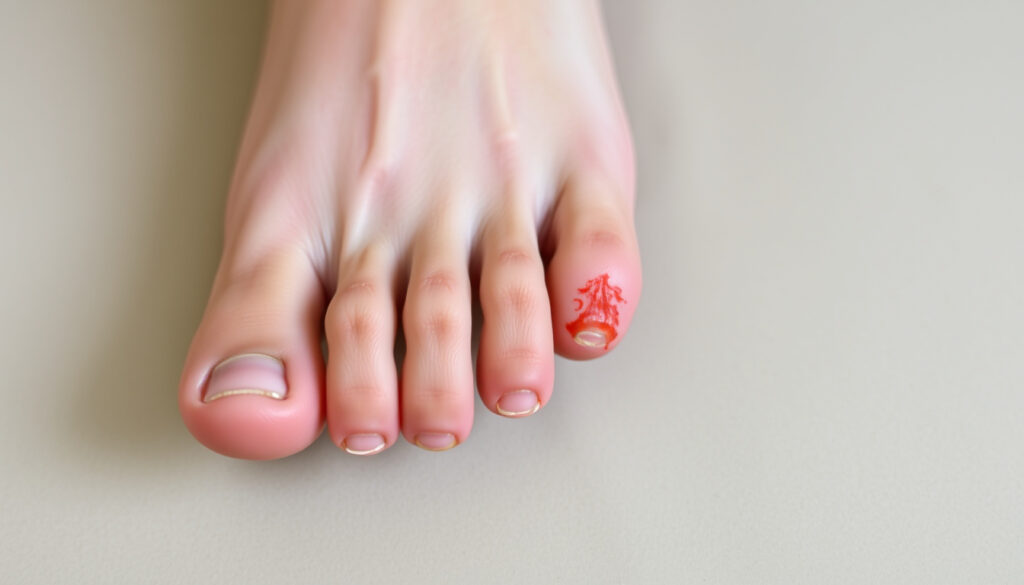
A bunion appears as a visible bump on the inner side of the foot at the base of the big toe. The skin over the bump may be red, swollen, and tender. The big toe itself angles toward the second toe — a hallmark of hallux valgus.
Is a bunion a bone or fluid?
It is bone. The PMC review article describes the bunion as a prominent and inflamed metatarsal head with an overlying bursa. The bump is the head of the first metatarsal bone that has shifted outward due to joint misalignment. It is not a cyst, a tumor, or a fluid collection — it is a structural bone deformity. Orthobullets (a medical education resource for orthopaedic surgeons) characterizes hallux valgus as a complex valgus deformity of the first ray.
The trade-off: Because it is a bone deformity, only surgery can remove the bump. But understanding the anatomy helps patients set realistic expectations: no amount of stretching, padding, or icing will make the bone go away.
Step-by-step guide to managing bunions
Whether you’re trying to avoid surgery or preparing for it, a structured approach helps. Below are the key steps, from diagnosis to post-operative care.
- Get an accurate diagnosis. See a podiatrist or orthopaedic foot specialist. X-rays confirm the severity of hallux valgus and rule out other conditions. (Cleveland Clinic)
- Optimize footwear. Switch to shoes with a wide toe box, low heel, and flexible sole. Avoid pointed toes and heels higher than 2 inches. (NHS Lanarkshire)
- Use padding and orthotics. Gel bunion pads, toe spacers, and custom orthotics reduce pressure and improve foot alignment. (PMC review)
- Manage pain and inflammation. Apply ice for 15 minutes after activity, take over-the-counter NSAIDs (e.g., ibuprofen) as needed, and consider physiotherapy for strengthening. (Mass General Brigham)
- Monitor progression. Take photos every 3–6 months to track changes. If pain worsens or the deformity increases, revisit your specialist. (Cleveland Clinic)
- Consider surgery when conservative care fails. If pain interferes with daily activities or the deformity progresses despite non-surgical measures, bunionectomy options include osteotomy (bone cutting and realignment) or arthrodesis (joint fusion). AAOS offers minimally invasive techniques for selected cases.
Most patients wait too long. Mass General Brigham’s guideline emphasizes that the vast majority of bunions can be managed successfully with basic non-operative treatment — but only if you start early. Every year of delay narrows the window for conservative care.
Confirmed facts
- Genetic predisposition is a major risk factor (Cleveland Clinic)
- Narrow footwear accelerates bunion formation (NHS Lanarkshire)
- Conservative treatments can manage symptoms and slow progression (PMC review)
What’s unclear
- Why some people with identical risk factors never develop bunions (Mass General Brigham)
- Exact rate of progression for each stage (PMC review)
- Long-term efficacy of different bunion corrector brands — limited comparative data
- Women are up to 10× more affected — the exact ratio may vary by population (Cleveland Clinic)
- Whether surgery is always the only definitive removal method — some non-surgical approaches may reduce the bump in early stages (NHS Lanarkshire)
What experts say about bunions
“A bunion is a bony bump that forms at the base of your big toe. Bunions are common — about 1 in 3 adults have them.”
“Bunions are caused by some of the bones in the front part of your foot moving out of place.”
“Surgery is the only way to get rid of them, but there are things you can do to ease any pain.”
— NHS Lanarkshire (Scottish national health service)
The upshot: The experts agree on the core message: bunions are a structural deformity that won’t disappear on its own, but pain can be managed, and surgery is effective when needed. The challenge is timing — catching it early enough to make conservative care work.
Summary
Bunions are not a cosmetic issue; they are a progressive joint deformity driven by genetics and exacerbated by footwear. Conservative measures — proper shoes, orthotics, ice, and physiotherapy — can keep symptoms in check for years, but they cannot reverse the bone misalignment. Surgery, while effective in 80–90% of cases, should be viewed as a last resort after a solid trial of non-surgical care. For anyone with a family history of bunions, the smartest move is to act early: buy wider shoes, see a podiatrist at the first sign of a bump, and monitor changes regularly. Ignoring the problem only makes the eventual fix harder.
joint-surgeon.com, sportsmedicinenewyork.com, surgicoll.scholasticahq.com, joint-surgeon.com, bocaratonfootcare.com
A detailed explanation of bunion symptoms and causes provides further insight into this common foot deformity.
Frequently asked questions
What caused my bunion, and what can I do about it?
Your bunion likely resulted from a combination of inherited foot structure and years of wearing shoes that squeeze your toes. The best immediate steps are to switch to wide, low-heeled shoes, use bunion pads, and consult a podiatrist for a personalized plan. (Cleveland Clinic)
Can bunions be prevented?
You cannot change your genetics, but you can reduce your risk by wearing shoes with a wide toe box, avoiding high heels, and maintaining a healthy weight to reduce pressure on your feet. Early intervention with orthotics may help if you have a family history. (NHS Lanarkshire)
How long does it take to recover from bunion surgery?
Recovery varies by procedure. Generally, you can expect to wear a surgical shoe for 6–8 weeks, with full return to activity in 3–6 months. Minimally invasive techniques may allow faster recovery. (AAOS)
Do bunion correctors really work?
Bunion correctors (splints, toe separators) can help alleviate pain and slow progression by realigning the toe during rest, but they cannot permanently straighten the joint. Evidence is limited on long-term efficacy. (PMC review)
Are bunion pads effective for pain relief?
Yes, gel bunion pads reduce friction and pressure over the bump, which can relieve pain during walking and wearing shoes. They are a simple, low-cost first-line treatment. (NHS Lanarkshire)
What shoes should I avoid with a bunion?
Avoid narrow-toed shoes, pointed toes, high heels (above 2 inches), and shoes with rigid soles. These increase pressure on the big toe joint and accelerate bunion progression. (Cleveland Clinic)
Can bunions come back after surgery?
Recurrence is possible, especially if the underlying biomechanical issues (e.g., pronation, tight shoes) are not addressed. Surgery success rates are 80–90%, but wearing proper footwear and maintaining foot strength reduces the chance of recurrence. (Mass General Brigham)
Related reading: Carpal Tunnel Syndrome: Causes, Symptoms & Treatment · What Is Sleep Paralysis? Causes, Symptoms, and How to Stop It
More related posts
 Anthony’s BBQ Sauce Recall: Life-Threatening Fish Allergen Risk
 Another Word for Because: 30+ Synonyms & Alternatives (2025 Guide)
 Hou ton Rocket v Denver Nugget Timeline: Key Game & Record
 Baked Potato in Oven: Perfect Time & Temp
 What Does the Prostate Do? Function, Location, & Conditions
 Ford Mustang Mach-E: 2026 Review, Price, and Buying Guide
 Cast of 16 Candles: Actors, Roles & Where They Are Now
 Brianne Howey Movies and TV Shows – Complete Filmography Guide
